The best Site24x7 alternatives are Hyperping for website and API checks with on-call and status pages, Better Stack for checks next to logs and incidents, UptimeRobot for inexpensive availability monitoring, Pingdom for synthetic reporting, Checkly for monitoring as code, Datadog when you need deeper observability, and Zabbix when you want to self-host infrastructure monitoring.
I analyzed 31 products and shortlisted seven. Each one replaces at least one thing people use Site24x7 for: public uptime, synthetic checks, incident response, full-stack observability, or self-hosted infrastructure. MSP remote-management suites and AI QA recorders are further down, because they do a different job.
Prices were checked in September 2026. The price that usually changes the shortlist is Site24x7's Web Uptime pack at $9 per month for 25 websites at a 1-minute interval. Faster checks cost a lot more: Site24x7's public list puts 30-second website checks on Enterprise Plus Web at $899/month. Hyperping Essentials is $24/month for 50 monitors at 30 seconds, with on-call and a status page included.
| Tool | Best for | Starting price | Main limitation |
|---|---|---|---|
| Hyperping | Website, API, on-call, and status pages in one plan | Free; $24/mo | No SNMP, Windows agent, or APM |
| Better Stack | Checks next to logs and incidents | Free; $29 per responder/mo | Per-user pricing plus log and page extras |
| UptimeRobot | Cheap public URL and SSL checks | Free; Solo $12/mo | No on-call; no browser checks |
| Pingdom | Transaction checks and real user monitoring | $16.50/mo for 10 checks | No free plan |
| Checkly | API and Playwright checks owned in Git | Free; Starter $24/mo | Billed per run; no on-call |
| Datadog | Deeper APM and infrastructure than Site24x7 | Infrastructure from $15/host/mo | Every product is billed separately |
| Zabbix | Self-hosted servers and SNMP | Free to self-host; Cloud from about $50/mo | You run the server and database |
Why trust this guide
I'm Léo, founder of Hyperping. Yes, that means I have a stake in one of these tools. But I've watched teams pick competitors when they were the better fit, and I'm not going to pretend otherwise. My goal isn't to convince you Hyperping is always the answer. It's to help you understand which tool actually solves your problem.
I went through Site24x7's pricing page, G2 and Capterra reviews, Reddit threads in r/sysadmin, r/sre, r/devops, and r/selfhosted, the docs for every tool on the list, and conversations with people running these tools in production, in September 2026.
Why people leave Site24x7
Start by deciding which part of Site24x7 you're replacing. Site24x7 is a Zoho product, and its homepage lists websites, servers, cloud, Kubernetes, networks, APM, RUM, synthetics, logs, AIOps, StatusIQ status pages, and MSP portals. People leave when they only used the website checks, when add-ons pushed the bill well past the $9 pack, or when they needed deeper traces or SNMP than the modules gave them.
| What you used Site24x7 for | If you stay | Look at |
|---|---|---|
| Homepage, API, SSL, Slack, status page | You pay for modules you don't open | Hyperping, UptimeRobot, Better Stack |
| Login or checkout journeys | Transaction monitors in Web Perf | Checkly, Hyperping, Pingdom, Uptime.com |
| Servers, SNMP, network devices | This is what the suite is good at | Zabbix, PRTG, Checkmk |
| APM, traces, logs, and RUM together | Site24x7 is cheaper than Datadog | Datadog, New Relic, Dynatrace, SigNoz |
| MSP customer accounts | MSP packs from $54/mo | Stay, or a dedicated RMM tool |
A focused uptime product will look empty if you depended on network discovery, and an observability platform will look expensive if you only needed 25 URL checks.
The console got crowded once I went past website checks
Site24x7's catalog is the selling point until you work in it every day, and navigation and advanced alerting take a while to learn. Reviewers comparing Better Stack with Site24x7 on G2 call Better Stack easier to set up and easier to admin, and the same page rates UptimeRobot as more usable and easier to set up than Site24x7.
From a December 2025 G2 review:
"Also, the UI could be more modern and less cluttered."
The $9 plan wasn't the whole bill
Web Uptime is $9/month for 25 websites, 1-minute checks, 32 locations, and 3 status pages. Server packs, APM, logs, RUM page views, faster intervals, and extra monitor types are billed separately, and SMS and voice alerts usually run on credits.
From an August 2026 G2 review:
"Additionally, pricing can become difficult to predict as monitoring requirements grow and additional features are added."
I only needed URLs, SSL, and a status page
In an r/sysadmin thread on Site24x7 alternatives, people pointed to UptimeRobot and Pingdom for simple uptime, and to Datadog for deeper infrastructure. That's the usual choice: keep the website checks and drop the suite, or pay more for observability. Hyperping and Better Stack sit between the two, replacing website checks, StatusIQ, and a pager, though neither watches network devices.
I outgrew Site24x7's APM
G2 reviewers comparing Datadog with Site24x7 say Datadog is slower to reach ROI. Keep Site24x7 if moderate APM depth at a lower price is enough, and move when your responders already live in Datadog or traces are the daily workflow.
I need SNMP on a box I control
In this r/sysadmin thread, someone on Site24x7 asks for an easier on-prem alternative, and Zabbix shows up in the replies. Checkmk comes up in older server monitoring threads. Hyperping and UptimeRobot won't watch a core switch.
Site24x7 alternatives compared
The biggest differences are network devices, APM, and whether a failed check pages someone.
| Capability | Site24x7 | Hyperping | Better Stack | UptimeRobot | Pingdom | Checkly | Datadog | Zabbix |
|---|---|---|---|---|---|---|---|---|
| Public HTTP and API checks | Yes | Yes | Yes | Yes | Yes | Yes | Yes | Yes, from servers you run |
| Browser checks | Transaction monitors | Playwright, 3 to 25 by plan | Playwright, extra cost | No | Transaction checks in Chrome | Playwright in code | Browser tests, billed per run | No |
| On-call scheduling | No; SMS and voice on credits | Yes | Yes | No, alerts only | No, alerts only | No | Datadog On-Call, sold separately | Alerts you set up yourself |
| Status pages | StatusIQ | 1, 3, or 10 by plan | 1 included, extras $12 | Yes | Public status pages and reports | Basic | Separate product | No |
| Server and host metrics | Server packs | Linux and macOS agent | Some host monitoring | No | No, separate SolarWinds product | No | Yes | Yes |
| SNMP and network devices | Yes | No | No | No | No | No | Network monitoring product | Yes |
| APM and traces | Yes | No | Logs; no code-level APM | No | No | No | Yes | No |
| Fastest standard check | 1 minute; 30s on Enterprise Plus Web | 30s; 20s on Business | 30s | 5 min free; 30s on Team | 1 minute | You choose, per run | You choose, per run | You choose |
| Hosting | Zoho SaaS | SaaS, EU data centers | SaaS | SaaS | SaaS | SaaS | SaaS | Self-hosted or Zabbix Cloud |
Site24x7 alternatives pricing compared
Site24x7 bills by pack and monitor type. The others bill by plan, by person on call, by run, by host, or in your own engineering time.
| Tool | Free plan | First paid plan | What it includes | Billed by | Watch out for |
|---|---|---|---|---|---|
| Site24x7 | 50 resources, email alerts | Web Uptime, $9/mo | 25 websites at 1 minute, 32 locations, 3 status pages | Pack and monitor type | 30-second checks need Enterprise Plus Web, $899/mo |
| Hyperping | 20 monitors, 5 min, 1 hosted status page | Essentials, $24/mo | 50 monitors at 30s, on-call, 3 browser checks, 3 seats | Plan | 1 status page on Essentials |
| Better Stack | 10 monitors, 1 status page | Responder, $29/mo | Uptime, on-call, incidents, status pages, unlimited phone and SMS | Person on call | Status page extras, Playwright, and logs cost more |
| UptimeRobot | 50 monitors, 5 min | Solo, $12/mo | 10 monitors at 60s, 3 status pages | Monitor | Solo has fewer monitors than Free |
| Pingdom | No; 30-day trial | $16.50/mo | 10 uptime checks, 1 advanced check, 50 SMS | Check count and page views | Real user monitoring is a separate bill |
| Checkly | 10,000 API runs a month | Starter, $24/mo | 25,000 API runs, 3,000 browser runs | Run | Frequent checks use runs fast |
| Datadog | Infrastructure for up to 5 hosts | Infrastructure Pro, $15/host/mo | Host metrics; synthetics, APM, and logs cost extra | Host, run, and product | Every product adds its own bill |
| Zabbix | Free to self-host | Zabbix Cloud, about $50/mo | Servers, SNMP, templates, auto-discovery | Engineering time or Cloud plan | You run the server and the database |
What 25 website checks cost
Say you have 25 public URLs and want each one checked every minute. That's what Site24x7's Web Uptime pack covers, so it's the baseline. This is my estimate from public pricing.
| Tool | What covers 25 checks every minute | Monthly cost | Note |
|---|---|---|---|
| Site24x7 | Web Uptime, 25 websites | $9 | Servers, APM, logs, and faster checks cost extra |
| Hyperping | Essentials, 50 monitors | $24 | Checks every 30 seconds, on-call, 1 status page |
| UptimeRobot | Team, 100 monitors | $39, or $0 at 5 minutes | Solo only has 10 monitors |
| Better Stack | One responder seat | $29 and up | Check how many monitors the seat includes today |
| Pingdom | 25 uptime checks, 4 advanced checks | $36.33, or $40 monthly | Includes 100 SMS a month |
| Checkly | Doesn't fit: about 1.08 million runs a month | Far past Team at $64 | Team includes 100,000 API runs |
| Datadog | About 1.08 million API test runs | About $540 | At $5 per 10,000 runs, before hosts and APM |
| Zabbix | Your own server | $0 self-hosted, or about $50 on Cloud | Plus the time to run it |
Site24x7 is the cheapest way to run 25 checks every minute, as long as the website pack is all you need. Hyperping costs $15 a month more and checks every 30 seconds with on-call included, where 30-second checks on Site24x7 mean Enterprise Plus Web at $899. Checkly and Datadog bill per run, so checking every minute is the expensive way to use them. If you outgrow 50 monitors, Hyperping Pro is $74/month for 250.
Site24x7 vs Hyperping
Site24x7 wins on breadth: websites, servers, networks, APM, and MSP accounts in one Zoho console. Hyperping wins on the path your customers see: 30-second checks on the $24 plan, Playwright browser checks, on-call with escalation, and status pages on the same plan. If you used Site24x7 for SNMP or Java traces, this is the wrong comparison, and the Better Stack vs Site24x7 vs Hyperping comparison goes into more detail.
| Capability | Site24x7 | Hyperping |
|---|---|---|
| Free plan | 50 resources, email alerts | 20 monitors, 5-minute checks, 1 hosted status page |
| Starting website plan | $9/mo for 25 sites at 1 minute, 32 locations, 3 status pages | Essentials, $24/mo for 50 monitors at 30s, 1 status page |
| 30-second checks | Enterprise Plus Web at $899/mo, or extra licenses | Included on Essentials |
| Browser checks | Transaction monitors in Web Perf | Playwright: 3, 10, or 25 depending on plan |
| On-call | Alerts; SMS and voice on credits | On-call, escalation, and incidents on every paid plan |
| Status pages | StatusIQ | 1 on Essentials, 3 on Pro, 10 on Business |
| SNMP and network devices | Yes | No |
| Windows agents and VMware | Yes | No |
| APM and traces | Yes | No |
| Host metrics | Server packs | Linux and macOS agent |
| MSP customer console | MSP packs from $54/mo | No |
| Hosting | Zoho SaaS | EU data centers |
| Billing | Packs, plus add-ons by monitor type | One plan with a monitor allowance |
Hyperping replaces Site24x7's website checks, StatusIQ, and a separate pager. If SNMP and traces are why you're on Site24x7, stay, or pair Hyperping with Zabbix or Datadog for those jobs.
Hyperping: Best for Site24x7 leavers who needed uptime, on-call, and a status page
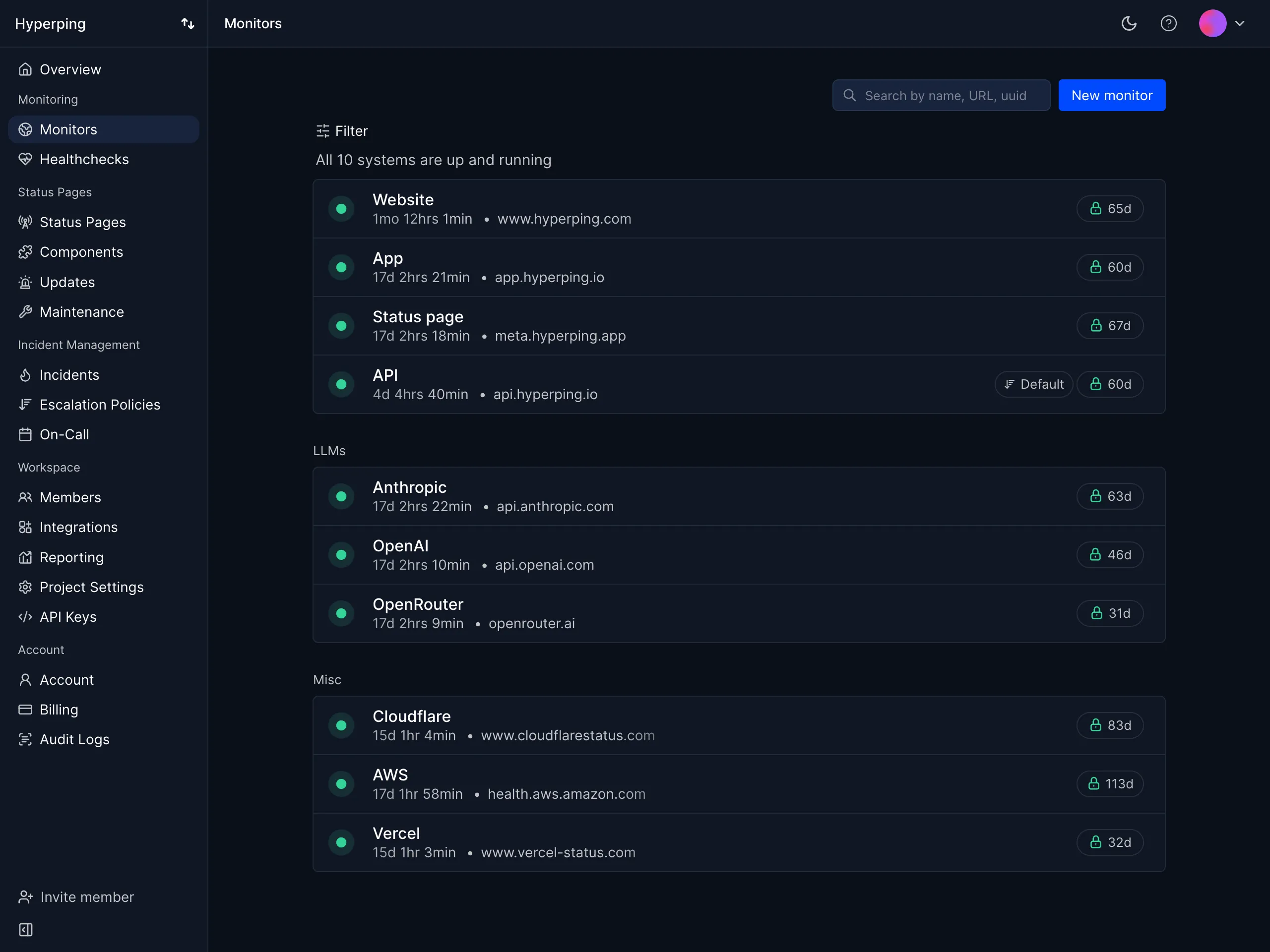
Hyperping combines HTTP and API monitors with SSL, Playwright browser checks, on-call schedules, escalation, incidents, and branded status pages. I built it for SaaS teams that want monitoring from the customer's side without a Zoho-sized console.
| Best for | Starting price | Main limitation |
|---|---|---|
| SaaS companies replacing website checks, StatusIQ, and a pager | Free, then $24/mo | No SNMP, Windows agent, or APM |
Who Hyperping is built for
People who used Site24x7 for public URLs, SSL, a status page, and alerts, and were paying for modules they never opened. Usually a handful of engineers who want 30-second checks, a retry from a second region, and a customer-facing status page in the same login.
Alma is the example I keep coming back to: a French fintech that already runs Datadog and still keeps Hyperping as a second opinion from outside the cluster.
Notable features
- 30-second checks. On Essentials and Pro, 20 seconds on Business.
- Multi-region confirmation. A failed check is confirmed from your other regions before an incident opens.
- Playwright browser checks. 3 on Essentials, 10 on Pro, 25 on Business.
- On-call and escalation. Slack, SMS, or phone call to whoever is on the rotation.
- Status pages. Connected to the same monitors and included on every plan.
- Server agent. A Linux and macOS OpenTelemetry agent for CPU, memory, disk, and network next to your uptime checks.
- EU hosting. Monitoring data stays in EU data centers.
Why choose Hyperping over Site24x7?
30-second checks are on the $24 plan. Site24x7's standard website packs check every minute. On its public price list, 30-second checks sit on Enterprise Plus Web at $899/month, or use extra licenses. Hyperping checks every 30 seconds from Essentials up.
On-call and a status page are on the same plan. A failed check is confirmed from another region, opens an incident, pages the rotation through Slack, SMS, or a phone call, and updates the linked status page. If you ran Site24x7 website checks plus StatusIQ plus a separate on-call tool, that's one bill instead of three.
You pay for monitors, not packs by type. Essentials is 50 monitors, on-call, and a status page for $24/month. Site24x7 bills website, server, APM, and RUM as separate packs.
What users say
Alma's SRE, Fabrice Gregoire:
"Hyperping's reputation in our company is that it's more reactive than Datadog. We usually get notifications from Hyperping before Datadog."
"Datadog charges per check. You have a package, that's better. Pay per use is annoying and expensive."
"We made our Hyperping status page publicly available and it became a crucial part of our sales pitches."
How much does Hyperping cost?
- Free: 20 monitors, 5-minute checks, 1 hosted status page, email and Slack alerts
- Essentials: $24/month ($29 monthly) for 50 monitors, 30-second checks, 1 status page, 3 browser checks, 3 seats, on-call and escalation, phone call alerts
- Pro: $74/month ($89 monthly) for 250 monitors, 3 status pages, 10 browser checks, 10 seats
- Business: $249/month ($299 monthly) for 1,000 monitors, 20-second checks, 10 status pages, 25 browser checks, 20 seats
Every paid plan has a 14-day free trial. Twenty-five website checks fit on Essentials at $24/month, checked every 30 seconds.
Where Hyperping falls short
We don't replace Site24x7's network, Windows, VMware, or APM modules. Our Linux and macOS agent reports host health next to your uptime checks, but it doesn't discover devices over SNMP, so if routers and Java traces are why you're on Site24x7, keep those modules or move them to Zabbix and Datadog. Browser checks run every 5 minutes and top out at 25 on Business, and Checkly is the better fit for a large Playwright suite.
Is Hyperping right for you?
Pick Hyperping if you're leaving because of the crowded console, add-on pricing, or 1-minute checks on public URLs. Skip it if you need SNMP, a Windows agent, or code-level APM in the same login.
Better Stack: Best for Site24x7 leavers who also wanted logs and incidents
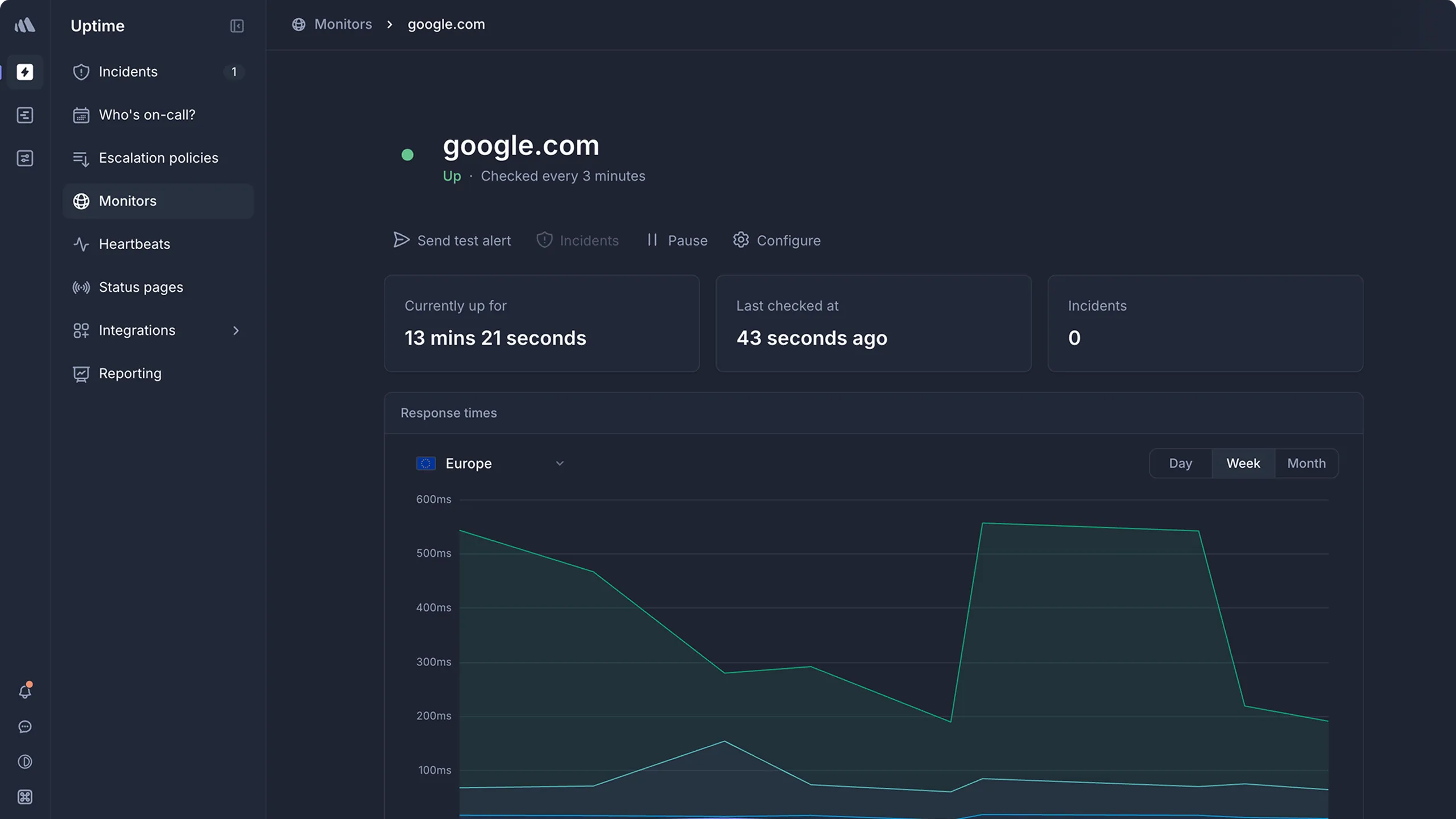
Better Stack puts HTTP checks in the same product as logs, on-call, incidents, and status pages. You pay per person on call, starting at $29/month.
| Best for | Starting price | Main limitation |
|---|---|---|
| People who investigate with logs in the same product | $29 per responder/mo | Extra monitors, Playwright minutes, and log volume |
Who Better Stack is built for
Startups and engineers who want the check, the page, the incident timeline, and the logs from one vendor. Usually people tired of wiring UptimeRobot to PagerDuty to a status page, who found Site24x7's console heavier than the investigation path they wanted.
G2's Site24x7 alternatives page shows why they switch: reviewers call Better Stack easier to admin, easier to set up, and better at support than Site24x7.
Notable features
- HTTP and API checks. JSON assertions on the response body.
- On-call. Schedules, escalation, phone, SMS, push, and email.
- Incidents. Slack and Teams workflows, timelines, post-mortems.
- Status pages. Public and private, with subscriber notifications.
- Logs and telemetry. In the same product, billed separately.
- Terraform and API. A Terraform provider and a REST API for the monitoring setup.
- Paid extras. More monitors, extra status pages, Playwright runtime, white-label, and SSO.
Why choose Better Stack over Site24x7?
The logs are next to the incident. Hyperping also bundles on-call and status pages. Better Stack adds logs and a more mature Slack and Teams incident workflow, where Site24x7 sells logs as another module in the console.
It's easier to set up. G2 reviewers comparing the two call Better Stack easier to set up and easier to admin. If the crowded console was your complaint, this is the usual next tab.
One responder seat is enough to start. $29/month covers uptime, on-call, incidents, and status pages. Extra monitors, Playwright minutes, and log volume are billed separately.
What users say
Reviewers like having everything in one place. From an August 2026 G2 review:
"I love using Better Stack for logging, telemetry, and alerting. It's been great for unifying data from our multiple services."
Price is the usual complaint, especially for small teams. From a March 2026 G2 review:
"The pricing can feel a bit high for small teams or individual developers. Also, some of the more advanced features and configuration options come with a learning curve."
How much does Better Stack cost?
- Free: 10 monitors and heartbeats, 1 status page, Slack and email alerts
- Responder: $29 per user/month ($34 monthly), with uptime, incidents, on-call, status pages, and unlimited phone and SMS
- Extra public status page: $12/month
- Status page extras: custom CSS, white-label, SSO, and IP allowlisting cost extra per page
For 25 website checks with on-call, you need at least one responder seat at $29/month. Check the current monitor allowance before you assume $29 is the whole bill, and budget logs separately if you turn them on.
Where Better Stack falls short
Per-user pricing and add-ons are harder to predict than Hyperping's plans. There's no SNMP, no Windows agent, and no Site24x7-style APM. White-label, SSO, and IP allowlisting on status pages cost more than on Hyperping Business. If you already run PagerDuty and Loki, you'll pay for things you have.
Is Better Stack right for you?
Pick Better Stack if the investigation after an alert matters as much as the check. Skip it if you already run PagerDuty and Loki, or if you need SNMP.
UptimeRobot: Best inexpensive Site24x7 alternative for basic uptime
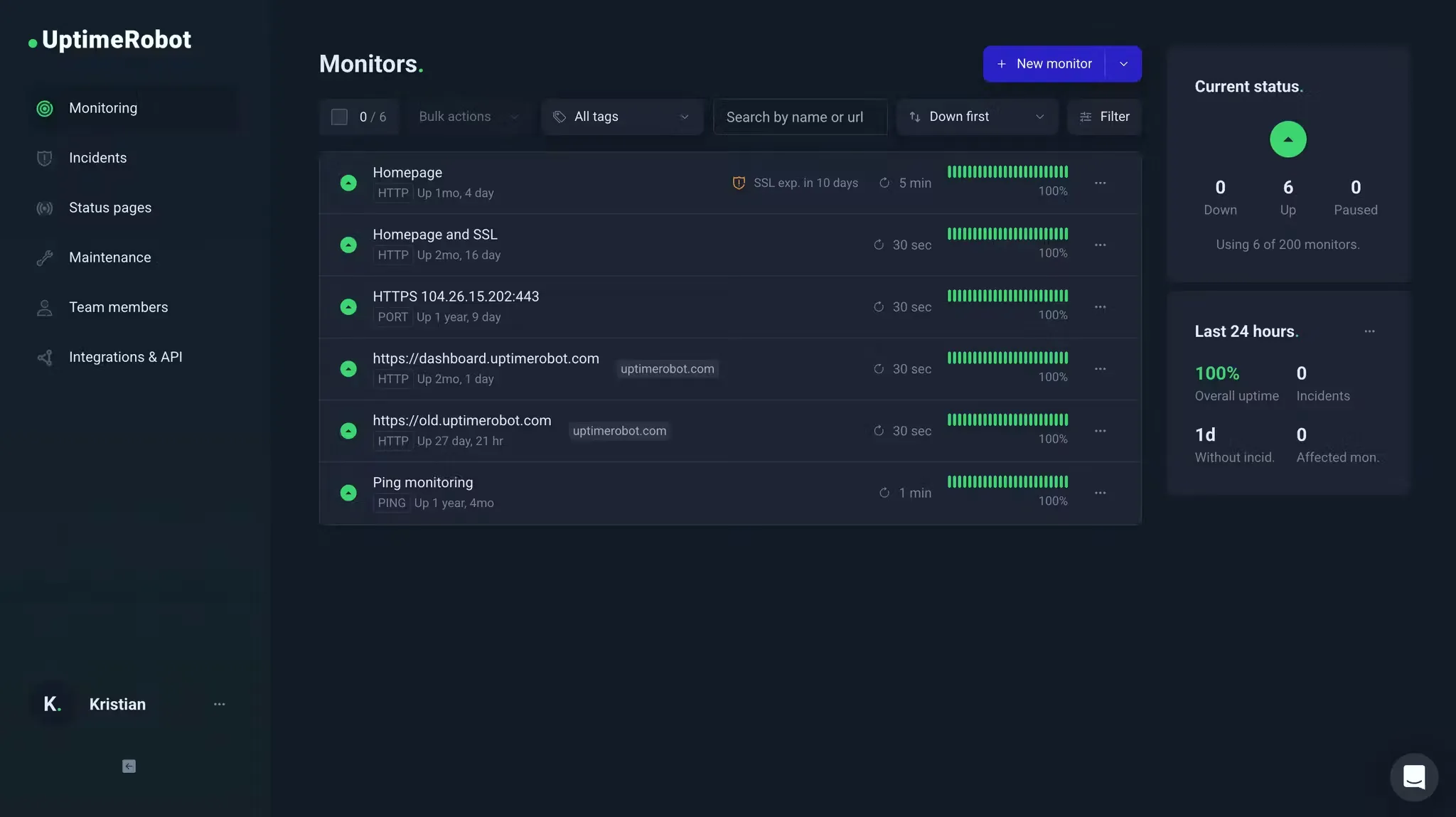
UptimeRobot has the biggest free plan here: 50 monitors at 5-minute intervals, with HTTP, keyword, SSL, and DNS checks. Paid plans start with Solo at $12/month.
| Best for | Starting price | Main limitation |
|---|---|---|
| Solo operators and lean teams | Free; Solo $12/mo | No on-call; no browser checks |
Who UptimeRobot is built for
People who were paying Site24x7 for public URLs and email alerts. In the r/sysadmin thread on Site24x7 alternatives, sysadmins named it for budget uptime, SSL, and DNS checks, with Pingdom for synthetics and Datadog for people who needed infrastructure. If StatusIQ, on-call, or login journeys were in daily use, look elsewhere.
Notable features
- Free plan. 50 monitors at 5-minute intervals.
- Monitor types. HTTP, keyword, SSL, and DNS.
- API monitors. JSON field checks on HTTP responses.
- Intervals. 60 seconds on Solo, 30 seconds on Team, 15 seconds on Scale.
- Status pages. 1 on Free, 3 on Solo, 100 on Team.
- Alerts. Email, Slack, and webhooks, with no on-call rotation.
Why choose UptimeRobot over Site24x7?
The free plan covers the website pack. 50 free monitors is twice the 25 websites in Site24x7's $9 Web Uptime pack. The catch is the interval: every 5 minutes on UptimeRobot Free, every minute on the Site24x7 pack.
G2 reviewers find it easier. The G2 comparison rates UptimeRobot more usable, easier to set up, and easier to admin than Site24x7. That fits a product that only checks URLs.
Team covers 25 checks every minute for $39. Team is $39/month for 100 monitors at 30 seconds and 100 status pages. You won't get Hyperping's on-call or Better Stack's incident timeline at that price.
What users say
People name UptimeRobot when they want to keep website checks and drop the rest of Site24x7.
"Yep, I've been using https://uptimerobot.com for years and very satisfied with both the effectiveness, simplicity and price."
How much does UptimeRobot cost?
- Free: 50 monitors, 5-minute checks, 1 status page
- Solo: $12/month for 10 monitors, 60-second checks, 3 status pages
- Team: $39/month for 100 monitors, 30-second checks, 100 status pages
- Scale: $83/month for 200 monitors, 15-second checks
Twenty-five website checks cost nothing if every 5 minutes is fast enough. Checking them every minute or faster needs Team at $39/month, because Solo stops at 10 monitors.
Where UptimeRobot falls short
No on-call rotation, no Playwright browser checks, and no SNMP. Status pages are simpler than StatusIQ. If you used Site24x7 because someone had to be woken up, move to Hyperping or Better Stack instead of a bigger UptimeRobot plan.
Is UptimeRobot right for you?
Pick UptimeRobot if you were paying Site24x7 for public URLs and email alerts. Skip it if StatusIQ, on-call, or login journeys were in daily use.
Pingdom: Best for synthetic reporting without the Zoho console
Pingdom is SolarWinds' website performance product. Transaction checks and real user monitoring are what you buy it for, and servers and SNMP are in a different SolarWinds product.
| Best for | Starting price | Main limitation |
|---|---|---|
| People who want transaction checks and RUM, not servers | $16.50/mo for 10 checks | No free plan; RUM is billed separately |
Who Pingdom is built for
People who used Site24x7's Web Perf and transaction monitors and wanted reporting without the rest of the Zoho console. Digital marketers, web hosts that need SLA proof, and companies that already know the Pingdom name. In the r/sysadmin thread on Site24x7 alternatives, people named it for simpler uptime plus synthetic checks. If you need one vendor for websites and SNMP, Pingdom doesn't get you there.
Notable features
- Uptime checks. From 100+ locations, with a 1-minute interval recommended in the docs.
- Transaction checks. Run in a real Chrome browser, as often as every 5 minutes.
- Real user monitoring. Visitors by browser, device, and geography.
- Page speed. Load time checks per page.
- Status pages and reports. Public pages you can hand to clients as SLA proof.
- Alerts. Email, SMS from a monthly allowance, and integrations.
- SolarWinds Observability. Infrastructure, APM, and logs are a separate SolarWinds product.
Why choose Pingdom over Site24x7?
Transactions and RUM without a suite. Site24x7 puts synthetics next to servers, APM, and MSP packs. Pingdom is the older product for whether the site is up, whether checkout works, and what real visitors saw.
The calculator price is the real starting price. Pingdom's USD calculator starts at $16.50/month ($18 monthly) for 10 uptime checks, 1 advanced check, and 50 SMS. Product pages still say it starts at $10 a month, so price your setup in the calculator.
Non-engineers already know it. If marketing or support owned the Site24x7 website checks, Pingdom is an easier sell to them than Checkly.
What users say
In r/sysadmin, people still name Pingdom when they want simpler uptime and synthetic checks without the Zoho console.
"Pingdom - simpler uptime + synthetic checks, client-friendly reports."
How much does Pingdom cost?
From the USD calculator:
- Trial: 30 days, with no free plan after it
- 10 uptime checks: $16.50/month ($18 monthly), with 1 advanced check and 50 SMS
- 25 uptime checks: $36.33/month ($40 monthly), with 4 advanced checks and 100 SMS
- Real user monitoring: from $16.50/month for 100,000 page views
Twenty-five website checks cost $36.33/month, about four times Site24x7's Web Uptime pack.
Where Pingdom falls short
There's no SNMP, no Windows agent, and no APM in Pingdom itself, and status pages are more limited than Hyperping's or StatusIQ. You're also buying from SolarWinds, which leads its site with its wider Observability product. Checkly is better for Playwright checks in Git, and Hyperping is better if you need on-call and a status page.
Is Pingdom right for you?
Pick Pingdom if reports and transaction checks are the job. Skip it if you need one vendor for websites and SNMP, or want a free plan while you test.
Checkly: Best Site24x7 alternative for monitoring as code
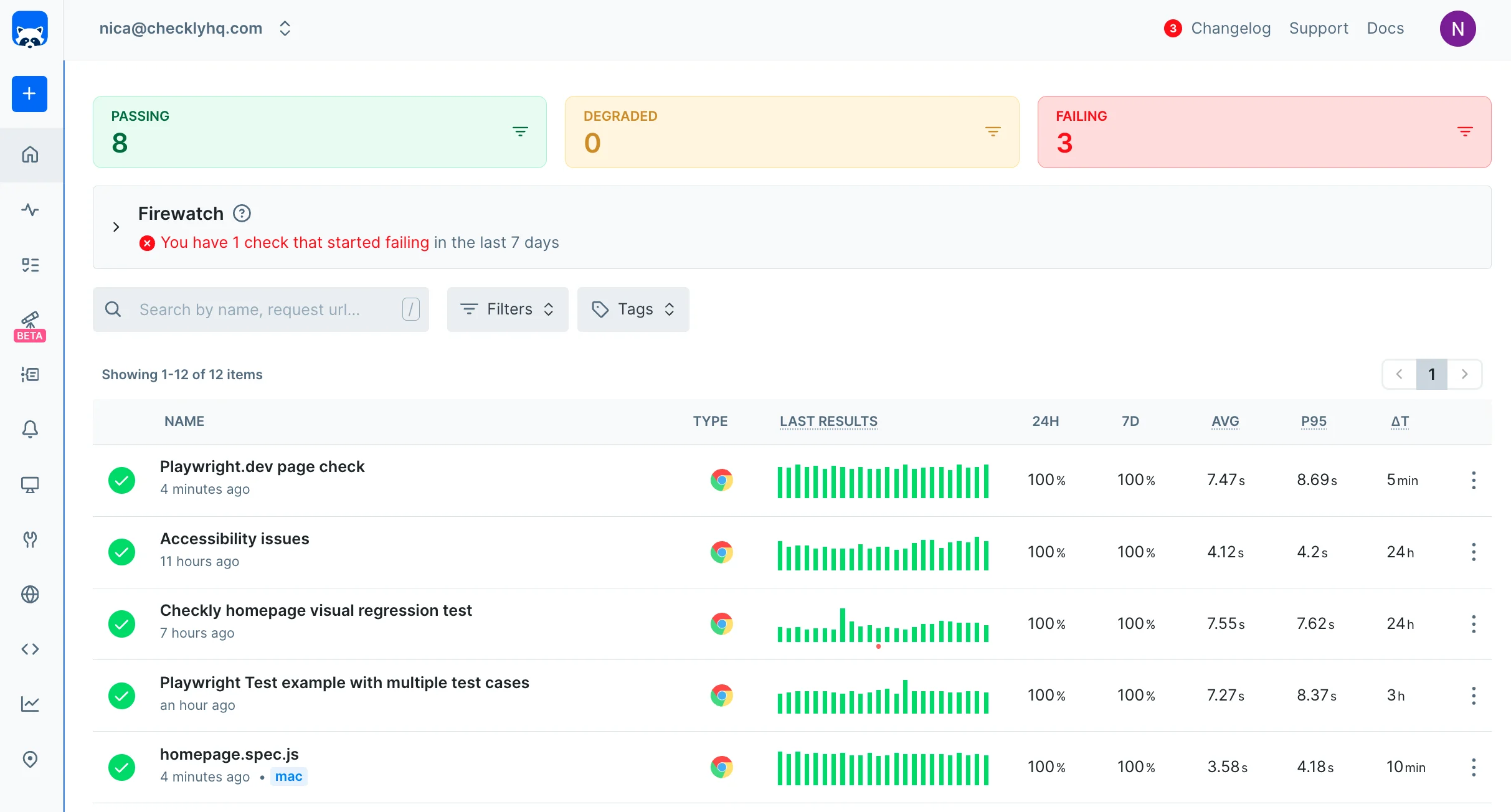
Checkly is for engineers who want their checks in code. You write them in TypeScript, review them in Git, and deploy them with a CLI. The free plan includes 10,000 API runs a month.
| Best for | Starting price | Main limitation |
|---|---|---|
| Developers replacing Site24x7 recorders with Playwright in CI | Free; Starter $24/mo | Billed per run; no on-call |
Who Checkly is built for
Developers who already review tests in Git and won't accept monitors that only exist in a Site24x7 recorder. Usually TypeScript, a CLI in CI, and a mix of API checks and Playwright browser checks. If non-engineers have to create monitors from a form, they'll struggle. In this r/sre thread, people leaving Site24x7 ask for synthetic monitoring, and Checkly is the name that comes up.
Notable features
- Checks as code. Written in TypeScript or JavaScript, versioned in Git, and deployed through a CLI.
- Browser checks. Playwright, in the same product as the API checks.
- Assertions. Status, latency, and specific fields in a JSON response.
- Multi-step API checks. Variables and tokens passed between requests.
- Locations. 6 on Hobby and Starter, 22 on Team, private locations on Team and above.
- CI/CD. Monitor changes go through pull-request review.
- Status pages. Basic, not a full customer status page product.
Why choose Checkly over Site24x7?
The checks live in Git. Site24x7's recorded transactions live in its dashboard. With dozens of Checkly checks, Git history tells you which version is running.
Playwright without the rest of a suite. Hyperping also runs Playwright, with a 5-minute browser interval and a small check allowance. Checkly bills per run, which suits engineers who already write the tests and doesn't suit someone who wanted three journeys and a pager on one plan.
The free plan is enough to try it. Hobby includes 10,000 API runs and 1,000 browser runs a month, which covers a trial or a few low-frequency checks.
What users say
Reviewers mostly talk about the Git workflow. From an August 2025 G2 review:
"What I like best about Checkly is its "monitoring-as-code" approach, which fits perfectly into modern CI/CD workflows. The ability to write API and browser checks in JavaScript/TypeScript using Playwright, commit them to Git, and run them globally is a game-changer."
How much does Checkly cost?
From Checkly's pricing page:
- Hobby: free, 10,000 API runs and 1,000 browser runs a month
- Starter: $24/month, 25,000 API runs and 3,000 browser runs
- Team: $64/month, 100,000 API runs, 12,000 browser runs, 22 locations, private locations
One API check every minute from one location uses about 43,200 runs a month, so Starter doesn't cover even one, and Team covers two. Twenty-five checks every minute is about 1.08 million runs, far past Team.
Where Checkly falls short
There's no on-call rotation and no SNMP, and status pages are basic. Nothing in Checkly replaces Site24x7's server agent. If non-engineers owned the Site24x7 recorders, Hyperping or Pingdom is the easier move.
Is Checkly right for you?
Pick Checkly if developers own the monitors. Skip it if non-engineers need a form-based workflow, or if you want server monitoring in the same login.
Datadog: Best when Site24x7 wasn't deep enough

Datadog is the observability upgrade. It goes deeper on APM, RUM tied to traces, Watchdog, and integrations, and it costs more.
| Best for | Starting price | Main limitation |
|---|---|---|
| Existing Datadog users, or people outgrowing Site24x7 APM | $15/host/mo, plus other products | The bill grows across infra, APM, logs, RUM, and synthetics |
Who Datadog is built for
People who already collect traces and logs in Datadog, or who outgrew Site24x7's APM module and are willing to pay per product. G2 reviewers comparing Datadog with Site24x7 say Datadog is slower to reach ROI. If you only needed 25 URL checks, Datadog is the expensive way to leave.
Notable features
- Infrastructure monitoring. $15/host/month on Infrastructure Pro.
- APM, logs, and RUM. Each one is a separate product, plus Watchdog for anomalies.
- Synthetics. API tests and browser tests, each billed per run.
- Correlation. A failed check shows up next to the trace and the log line.
- Network monitoring. Available as a separate product.
- Integrations. Across the rest of the Datadog catalog.
Why choose Datadog over Site24x7?
Traces are your daily workflow. Site24x7 APM covers Java, .NET, PHP, and Node at a lower price. Datadog is the move when responders already work in Datadog, or when going from RUM to the trace is how you investigate and Site24x7 didn't go deep enough.
Synthetics sit next to the rest of the platform. A failed check next to the trace is why people pay for Datadog after Site24x7 APM. Hyperping and UptimeRobot stop at the outside check.
You may already pay for it. The easy Datadog buy is adding synthetics to an account you already have. Setting Datadog up from zero after Site24x7's website packs is a much bigger project.
What users say
Cost is the complaint that repeats. From an April 2026 G2 review:
"Datadog is costly, and the expenses may increase quicker than you anticipate."
From a May 2026 G2 review:
"Configuring complex multi-step Synthetic Monitoring tests can be time-consuming, and the web UI occasionally feels sluggish when navigating through large, data-heavy dashboards during critical debugging sessions."
How much does Datadog cost?
- Infrastructure Pro: $15/host/month
- Synthetic API tests: $5 per 10,000 runs
- Synthetic browser tests: $12 per 1,000 runs
- APM, logs, RUM, and network: separate products, each billed on its own
Twenty-five API checks every minute from one location is about 1.08 million runs a month, or about $540/month at $5 per 10,000, before any hosts or APM. Moving from Site24x7 to Datadog usually means infrastructure plus APM plus synthetics, which is a much bigger bill.
Where Datadog falls short
Per-product billing and a lot of platform to learn, and G2's comparison says it's slower to reach ROI than Site24x7. You still need Datadog On-Call or PagerDuty, plus a status page product, if those were StatusIQ jobs. Hyperping covers that response path without the rest of the platform.
Is Datadog right for you?
Pick Datadog if you outgrew Site24x7 APM or already work in Datadog. Skip it if you only needed public URL checks and a status page.
Zabbix: Best self-hosted alternative to Site24x7 infrastructure
Zabbix is the open-source infrastructure monitor. You run the server, the database, and the templates yourself, or you buy Zabbix Cloud.
| Best for | Starting price | Main limitation |
|---|---|---|
| IT ops who want servers and networks on-prem | Free to self-host; Cloud from about $50/mo | You run server, database, and templates |
Who Zabbix is built for
IT ops people who used Site24x7's server and network packs and want SNMP, templates, and auto-discovery on a box they control. The r/sysadmin thread asking for an easier on-prem alternative to Site24x7 is typical. Zabbix won't replace Site24x7's website synthetics or status pages on its own, so pair it with a public uptime tool if customers still need a status page.
Notable features
- SNMP, agents, and templates. For servers, network devices, and applications.
- Auto-discovery. Finds hosts and devices on your network.
- Self-hosted. No license cost.
- Zabbix Cloud. From about $50/month if you don't want to run it.
- Alerting. Rules and routing you configure yourself.
- Status pages. None for customers.
Why choose Zabbix over Site24x7?
No license bill. Site24x7 is managed SaaS with cloud integrations. Zabbix costs nothing to license and has deeper templates, and you pay for it in engineering time.
SNMP is the main job. Hyperping, UptimeRobot, Pingdom, and Checkly won't watch a core switch. If that's why you bought Site24x7, Zabbix, PRTG, and Checkmk are the shortlist.
You can stay off the public cloud. Some of the people asking in r/sysadmin want on-prem because of policy, and the website module had nothing to do with it.
What users say
G2's Site24x7 alternatives page says reviewers find Zabbix slower to reach ROI than Site24x7, which fits a tool you have to run yourself. From a May 2026 G2 review:
"The UI feels slightly outdated in some areas, and fine-tuning alerts requires experience to avoid excessive notifications."
People leaving Site24x7 for Zabbix in r/sysadmin talk about the console more than the license.
"I'm looking at spinning up a Zabbix VPS just to get away from Site24x7 UI."
How much does Zabbix cost?
- Self-hosted: free license, plus the engineering time to run it
- Zabbix Cloud: listed around $50/month
Twenty-five public URL checks cost $0 in licenses on a server you run, or about $50/month on Cloud. You'll still want a public uptime tool with a status page for the customer-facing side.
Where Zabbix falls short
You operate the server, the database, and the templates, and the UI looks dated next to Better Stack and Datadog. Website synthetics and status pages aren't what it's for, so Hyperping or UptimeRobot covers those. G2's comparison also calls it slower to reach ROI than Site24x7, the SaaS you were leaving.
Is Zabbix right for you?
Pick Zabbix if the Site24x7 server and network packs were what you used. Skip it if you only needed public URL checks, and pair it with Hyperping or UptimeRobot if customers still need a status page.
Head-to-head
Site24x7 vs Datadog
Datadog wins on depth: APM, RUM tied to traces, Watchdog, a bigger integration catalog, and synthetics next to the trace and the log line. Site24x7 wins on price and time to value, since its APM covers Java, .NET, PHP, and Node for less and G2 reviewers say Datadog is slower to reach ROI. Pick Datadog if your responders already work in it or traces are the daily workflow, and stay on Site24x7 if moderate APM depth at a lower price is enough.
Site24x7 vs Zabbix
Both watch servers and network devices over SNMP. Site24x7 is managed SaaS with cloud integrations, website checks, and StatusIQ in the same console, while Zabbix is free to self-host with deeper templates and auto-discovery but leaves you running the server, the database, and the alerting, with no customer status page. Pick Zabbix if policy keeps you on-prem or you'd rather pay in engineering time than licenses, and stay on Site24x7 if you want someone else to run it.
Site24x7 vs UptimeRobot
For plain website checks, UptimeRobot is simpler and cheaper to start: the free plan has 50 monitors against the 25 websites in Site24x7's $9 pack, and G2 reviewers rate it easier to set up and admin. Site24x7 checks every minute on that pack, while UptimeRobot Free checks every 5 minutes and Team costs $39/month for 30-second checks. UptimeRobot has no servers, APM, or SNMP. Pick UptimeRobot if all you watch is public URLs, and stay on Site24x7 if website checks are one module among several you use.
Site24x7 vs Pingdom
Both sell website and transaction checks with reports. Pingdom focuses on uptime, transaction checks in a real browser, page speed, and real user monitoring, where Site24x7 puts the same jobs next to servers, APM, and MSP packs. Site24x7 is cheaper for plain checks: 25 websites at 1 minute cost $9/month, against $36.33 on Pingdom's calculator. Pick Pingdom if non-engineers own the reports and you don't need servers, and stay on Site24x7 if you want one vendor for websites and infrastructure.
Which one should you pick?
| Buyer or situation | Recommended tool | Reason |
|---|---|---|
| SaaS company using Site24x7 for URLs, SSL, and StatusIQ | Hyperping | 30-second checks, on-call, and a status page for $24/mo |
| People who read logs during incidents | Better Stack | Incident timeline and logs in one product |
| Tight budget, public endpoints only | UptimeRobot | 50 free monitors |
| Transaction reports without a suite | Pingdom | Transaction checks and real user monitoring |
| Engineers who want monitors in Git | Checkly | CLI and Playwright |
| Outgrew Site24x7 APM | Datadog | Traces and integrations |
| Servers and SNMP on-prem | Zabbix | Open-source infrastructure monitoring |
| Already on Grafana and k6 | Grafana Cloud | Listed below |
| EU agency that wants per-site health checks | Oh Dear | Listed below |
If you only need website checks and want to spend under $10 a month, Site24x7's Web Uptime pack is hard to beat, and UptimeRobot's free plan is cheaper still if every 5 minutes is enough. Between $24 and $40 a month, Hyperping, Better Stack, UptimeRobot Team, and Pingdom all cover 25 checks, and the choice comes down to whether someone gets paged and whether you need browser checks. Datadog only makes sense above that, once you're paying for hosts and APM anyway.
If you already pay for PagerDuty, you don't need Hyperping or Better Stack for the on-call side, and UptimeRobot or Pingdom can send alerts into it. If you already run Datadog, try its synthetics before you buy another tool, and keep an outside check as a second opinion the way Alma does with Hyperping. If you're keeping Site24x7 for servers and networks, you can still move the website checks and the status page out.
Other credible options
Other uptime and reliability products
| Tool | Main strength | Main limitation | Good for |
|---|---|---|---|
| Uptime.com | Many locations, private locations, subaccounts | Enterprise pricing | Ops teams with SLA reporting |
| Oh Dear | EU hosting, per-site health checks | Billed per site | Agencies watching many client sites |
| StatusCake | Uptime plus SSL, with data residency notes | No Playwright browser checks | Lots of cheap basic checks |
| Pulsetic | 30-second checks and unlimited status pages | No on-call; no Playwright | Agencies with a status page per client |
| HostTracker | Flat plan, 300+ check locations | 1-minute fastest interval | Simple checks from many locations |
| Xitoring | Cheap uptime, SSL, and server monitoring | No real-browser checks | Small shops watching sites and servers |
| Grafana Cloud | k6 scripted checks | You need to know Grafana | People already on Grafana |
| Cronitor | Heartbeats plus uptime | Narrower than a suite | Anyone with many cron jobs |
Other observability and infrastructure products
| Tool | Main strength | Main limitation | Good for |
|---|---|---|---|
| New Relic | APM plus synthetics | Billed by seats and data ingest | People already on New Relic |
| Dynatrace | Enterprise observability | Cost | Large companies with big estates |
| SigNoz | OpenTelemetry, cloud or self-hosted | No SNMP or MSP features | Developers who start from traces |
| LogicMonitor | SaaS infrastructure, cloud, and network monitoring | Enterprise procurement | IT teams that want network monitoring as SaaS |
| PRTG | SNMP and sensors | Runs on Windows | Network admins |
| Checkmk | Hybrid auto-discovery | Dated UI | Mixed on-prem and cloud estates |
| WhatsUp Gold | On-prem network monitoring | No SaaS uptime checks | Network operations centers |
| Netdata | Per-second host charts | No status pages | Host metrics at high resolution |
| Prometheus | Free metrics | You operate it | People who want to run their own stack |
| Uptime Kuma | Free self-hosted UI | One location unless you run more | Homelabs and small teams |
Atera, N-central, and ConnectWise are RMM tools for MSPs, so they're not on this list. ObserveOne is an AI QA recorder rather than a monitoring tool, and ManageEngine OpManager keeps you with the same vendor.
How to test a Site24x7 alternative
Test against the Site24x7 modules you actually turned on. Here's what each tool gives you to try it:
- Hyperping: 20 monitors on the free plan, plus a 14-day trial of paid plans
- Better Stack: 10 monitors and 1 status page on the free plan
- UptimeRobot: 50 monitors at 5-minute intervals on the free plan
- Pingdom: 30-day trial, no free plan
- Checkly: 10,000 API runs a month on the free Hobby plan
- Datadog: 14-day trial
- Zabbix: free to self-host, or a Zabbix Cloud trial
- Site24x7: keep your current plan, or the free plan for 50 resources, running while you test
Then break things on purpose:
- Move the public checks first. Recreate the Site24x7 HTTP, SSL, DNS, and API checks you care about, and leave APM, SNMP, and RUM until you have a replacement for them.
- Rebuild one revenue path. If Site24x7 had a transaction monitor for login or checkout, rebuild it as a browser check.
- Return HTTP 200 with the wrong content, and confirm the tool alerts on the body, not only the status code.
- Run the same check from two regions, then block one. See whether the alert tells a regional blip apart from a global outage.
- Ignore an alert. Check who gets paged next, whether it escalates, and how acknowledging stops it.
- Publish a status page and trigger a maintenance window. Ask someone who doesn't work in monitoring whether the page makes sense.
- After a week, price your exact setup: checks, interval, locations, seats, SMS, logs, RUM, and servers.
- Run both tools on the same URLs before you cancel a pack, and move one module at a time instead of the whole suite in one night.
Give every monitor an owner. A check nobody trusted in Site24x7 will get muted in the new tool too.
Related reading
- Better Stack vs Site24x7 vs Hyperping: the three-way comparison this list extends
- Best UptimeRobot alternatives: if you're coming from the cheap uptime side instead
- Hyperping pricing: monitors, status pages, and seats by plan
FAQ
What are the best Site24x7 alternatives? ▼
The best Site24x7 alternatives depend on what you actually used. Hyperping fits website, API, on-call, and status pages on a flat plan. Better Stack fits people who also want logs and incidents. UptimeRobot fits inexpensive availability checks. Pingdom fits synthetic reporting. Checkly fits monitoring as code. Datadog fits deeper observability. Zabbix fits self-hosted infrastructure.
Why do people leave Site24x7? ▼
The recurring reasons are a crowded console, a learning curve once you go past basic uptime, add-on pricing that's hard to forecast, and credit-based SMS or voice alerts. Some people only needed website checks. Others outgrew Site24x7's APM and tracing depth.
Is Site24x7 good for small businesses? ▼
Yes, if you'll use several modules. Website, server, cloud, and MSP packaging start around $9 per month. If you only need public URL checks and a status page, a focused uptime product is usually simpler and easier to price.
What is a cheaper alternative to Site24x7? ▼
UptimeRobot's free plan covers 50 monitors. Hyperping's free plan covers 20 monitors with 5-minute checks, then $24 per month for 50 monitors, 30-second checks, on-call, and a status page. Site24x7's Web Uptime plan is $9 per month for 25 websites at a 1-minute interval.
Does Site24x7 have a free plan? ▼
Yes. Site24x7 publishes a free forever plan for up to 50 resources with email alerts, plus a 30-day trial of paid packs. Paid website monitoring starts at $9 per month.
Can Hyperping replace all of Site24x7? ▼
No. Hyperping replaces the outside-in reliability path: HTTP and API checks, SSL, Playwright journeys, on-call, incidents, and status pages. It doesn't replace SNMP network monitoring, Windows agents, code-level APM, or an MSP customer console.