




The UptimeRobot alternative built for production teams
Move beyond basic uptime checks with 30-second monitoring from 19 regions, real browser checks, on-call scheduling, and customer-facing status pages. Paid plans include team seats, with additional seats available as you grow.
Close in price. Not close in what you get.
UptimeRobot's Team plan and Hyperping Essentials cost about the same. Here is what each of those dollars buys.
Read the Alma case studyHyperping's reputation in our company is that it's more reactive than Datadog. We usually get notifications from Hyperping before Datadog.

More than an uptime checker.
One focused workflow for detecting issues, reaching the right people, and keeping customers informed.
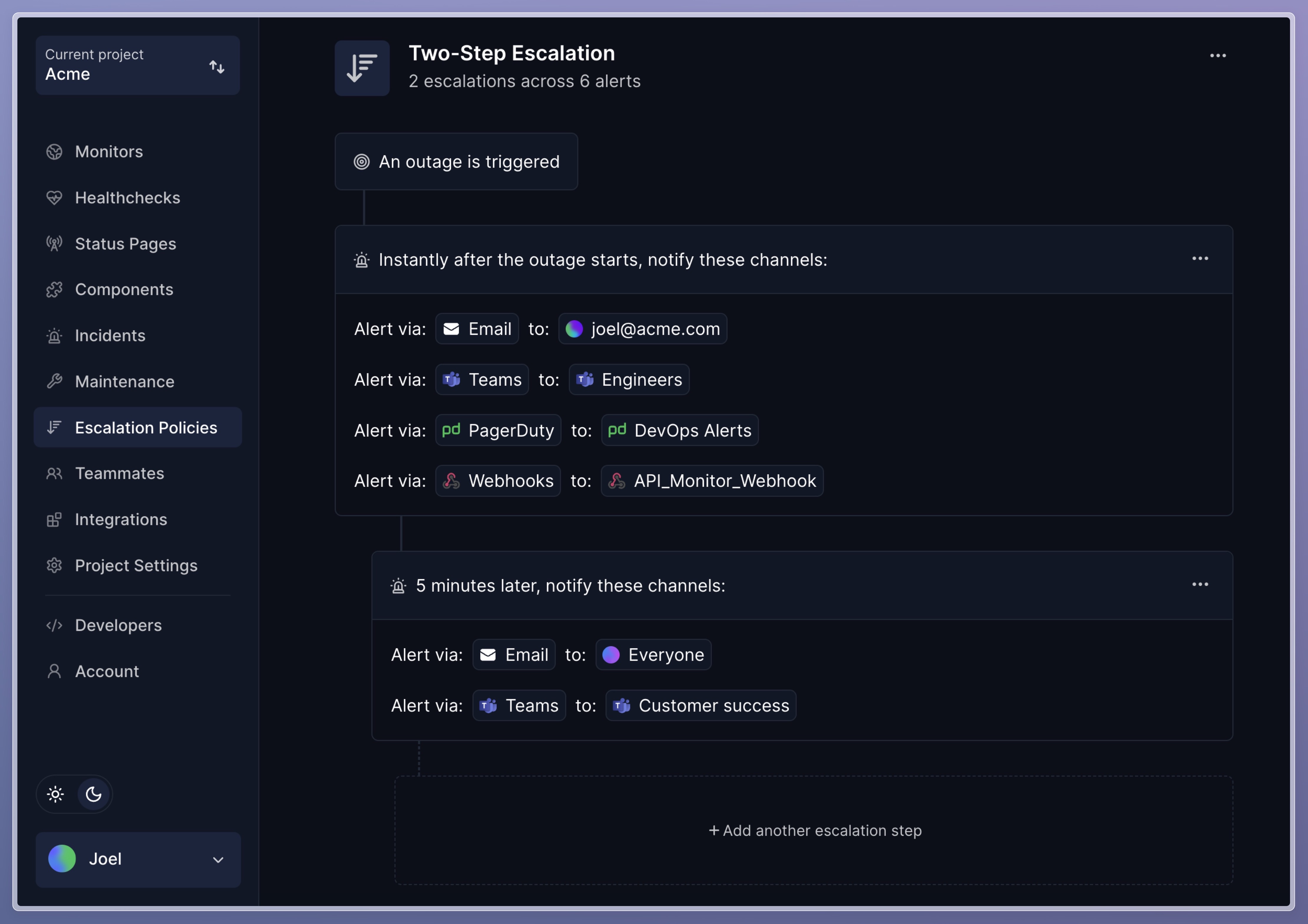
Escalate an outage until the right person answers.
Create timed notification steps, assign responders, and keep the incident workflow next to the monitors that triggered it.

No false positive alerts
A failed check is re-verified from other regions before anyone gets paged.
Escalation policies
Route unanswered alerts through timed steps instead of relying on one notification.
Browser checks with Playwright
Test logins, checkouts, and critical journeys with real Playwright scripts.
Advanced status pages
Give customers a branded page, with private access and component-level status.
Which means Hyperping offers better value than Uptime Robot
A straightforward view of what each plan gives your team.
Free tier
Uptime Robot offers 50 monitors with 5-minute intervals and a status page for free.
Hyperping offers 20 monitors with 5-minute intervals and a status page for free, commercial projects included.
Uptime Robot clearly wins on quantity here, but you might find yourself locked in if you eventually need advanced features that only Hyperping provides.
Professional monitoring
Uptime Robot starts at $7/mo for 10 monitors with 1-minute intervals.
Hyperping starts at $24/mo with 50 monitors at 30-second intervals and 2 seats included, plus integrations that aren't available until Uptime Robot's higher-tier plans.
Advanced features
Uptime Robot's higher tiers mainly add more monitors, with 30-second intervals only available on their most expensive plan.
Hyperping includes synthetic monitoring, escalation policies, and advanced status pages in its paid tiers, features you simply can't get with Uptime Robot at any price.
Bottom line
UptimeRobot is cheaper per monitor — and that's the whole pitch. The moment your team needs escalation policies, on-call rotations, browser checks, or a status page you'd put in front of enterprise customers, you're bolting on second and third tools.
Hyperping includes all of it in one plan: monitoring, status pages, incident management, and on-call. For a production team, that's both cheaper and simpler than UptimeRobot plus the tools you'd need around it.
Frequently asked questions
The practical details teams usually want to know before making the switch.
Start migrating in minutes. Cut over when you are ready.
Move from UptimeRobot without creating a blind spot. The guides below cover setup, parallel verification, and the final cutover.
Inventory your UptimeRobot setup
List checks, alert routes, status pages, and the historical reports you want to keep.
Open migration guideRecreate monitoring and alerting
Add monitors, connect notification channels, and rebuild escalation or on-call rules.
Follow the quickstartRun both tools, then cut over
Compare alerts in parallel, verify customer communication, and only then retire the old setup.
Open the go-live checklistHyperping vs. other tools
See the same feature-by-feature breakdown for the monitoring and incident tools on your shortlist.