The best UptimeRobot alternatives are Hyperping (monitoring + on-call + status pages at a flat rate), Better Stack (monitoring + logs + incidents), Pingdom (RUM + transaction monitoring), Uptime.com (synthetic monitoring + SLA verification), and Cronitor (cron job + uptime monitoring). I analyzed 35 tools total and narrowed it to these five based on hundreds of G2 and Capterra reviews, product research, and conversations with DevOps teams.
Most teams outgrow UptimeRobot for one of three reasons: no synthetic monitoring or browser checks for testing real user flows, no on-call scheduling or escalation policies for incident response, or limited diagnostics that tell you something is down but not why.
In this guide, you'll learn:
- Why teams leave UptimeRobot (based on real user feedback, not speculation)
- Five alternatives that solve specific problems UptimeRobot doesn't
- Honest pricing comparisons with actual numbers
- Which tool fits your team size, technical maturity, and budget
If you want monitoring that catches issues in 30 seconds, status pages that strengthen customer trust, on-call scheduling with smart escalation policies, and pricing you can actually predict, Hyperping delivers exactly that. Schedule a demo to see how it works.
Key takeaways
- Hyperping is the most cost-effective option starting at $24/mo flat-rate with included seats and paid additional seats: includes monitoring, on-call, and status pages.
- Better Stack combines uptime monitoring, log management, and incident response in a unified platform, but costs rise quickly from a generous free tier.
- Pingdom offers real user monitoring (RUM) and transaction monitoring with 100+ global probe locations, starting at $18/mo.
- Uptime.com offers the broadest set of check types (30+) with no-code synthetic monitoring, private location probes, and strong SLA reporting starting at $7/mo.
- Cronitor is the strongest choice for teams that rely heavily on cron jobs and background tasks, combining heartbeat monitoring with uptime checks starting at $7/mo.
Why you should trust this guide
I'm Léo, founder of Hyperping. Yes, that means I have a stake in one of these tools. But I've seen teams choose competitors when they were genuinely the better fit. My goal isn't to convince you Hyperping is always the answer. It's to help you understand which tool actually solves your problem.
I've analyzed hundreds of G2 and Capterra reviews, tested platforms myself, reviewed detailed product analyses, and talked to engineering teams about their experiences. Where I couldn't test something directly, I relied on verified user feedback and documented sources.
Top picks at a glance
| Best for | Product |
|---|---|
| Cost-effective monitoring + on-call + status pages | Hyperping |
| Unified monitoring + logs + incident management | Better Stack |
| Real user monitoring + transaction checks | Pingdom |
| Synthetic monitoring + SLA verification | Uptime.com |
| Cron job and background task monitoring | Cronitor |
Why teams consider UptimeRobot alternatives
UptimeRobot has earned its place as one of the most popular uptime monitoring tools since launching in 2010. With more than 3.4 million users and one of the most generous free plans in the category, it does basic monitoring well. But as teams grow and their monitoring needs become more complex, several pain points push them to look elsewhere.
No synthetic monitoring or browser checks
UptimeRobot checks if your endpoints respond, but it can't test whether your checkout flow actually works, whether your login page renders correctly, or whether a third-party script is breaking your user experience. One G2 reviewer noted directly: "Uptime does not seem to have progressed as much in its feature set as other services like BetterStack, which allows functionality such as using Playwright test scripts."
For teams running SaaS products or e-commerce sites where user flows matter as much as uptime, this is a significant gap.
No on-call scheduling or escalation policies
UptimeRobot sends alerts, but it doesn't manage who receives them at 3 AM on a Saturday. There's no on-call rotation, no escalation to a backup if the primary responder doesn't acknowledge, and no timezone-aware scheduling. Teams using UptimeRobot typically need a separate tool like PagerDuty for incident response, which adds cost and complexity.
Limited diagnostics beyond "up or down"
UptimeRobot tells you something is down and tracks basic response times. But when you need to understand why something went down, you're on your own. There's no APM, no real user monitoring, no detailed performance analytics, and no trace analysis. Host-level signals like CPU saturation or a filesystem filling up stay invisible until a check finally fails, which is exactly the gap agent-based monitoring closes. A reviewer on SoftwareAdvice put it this way: customization of alerts and reports can be "somewhat basic compared to more advanced monitoring tools."
Keyword monitoring doesn't handle modern websites
UptimeRobot's keyword monitoring doesn't recognize content loaded dynamically through JavaScript. As one G2 reviewer noted: "This limits monitoring options for modern websites or apps that rely heavily on client-side rendering." If your site uses React, Vue, or any other SPA framework, keyword checks won't catch content failures.
Pricing quirks at scale
(Full tier-by-tier numbers, including seat and SMS add-ons, are in our UptimeRobot pricing breakdown.)
While UptimeRobot's free tier is generous, several reviewers note that paid plans can "become pricey quickly as you scale up." Solo cuts you from 50 free monitors to 10, Team is $39 to $46 for 100 monitors, and Scale more than doubles that for 200. In November 2024, UptimeRobot also announced, then quietly reversed, a ban on commercial use of the free tier after heavy backlash, without a clear public walk-back. Most content online still claims the free plan is non-commercial only, which makes the terms hard to trust if you're building a business on it.
Quick comparison: UptimeRobot alternatives
| Tool | Starting Price | Best For | Main Limitation |
|---|---|---|---|
| Hyperping | $24/mo (50 monitors) | SMBs wanting monitoring + status pages + on-call | Not a full observability platform |
| Better Stack | $29/mo | Teams wanting monitoring + logs + incidents unified | Costs rise quickly from free to paid |
| Pingdom | $18/mo (10 monitors) | Teams needing RUM and transaction monitoring | Pricing escalates quickly at scale |
| Uptime.com | $7/mo (10 checks) | Teams needing SLA verification and synthetic testing | No on-call scheduling or escalation |
| Cronitor | $7/mo | Teams with critical cron jobs and background tasks | Per-monitor pricing adds up at scale |
Hyperping: Best for cost-effective monitoring with on-call and status pages
Who Hyperping is built for
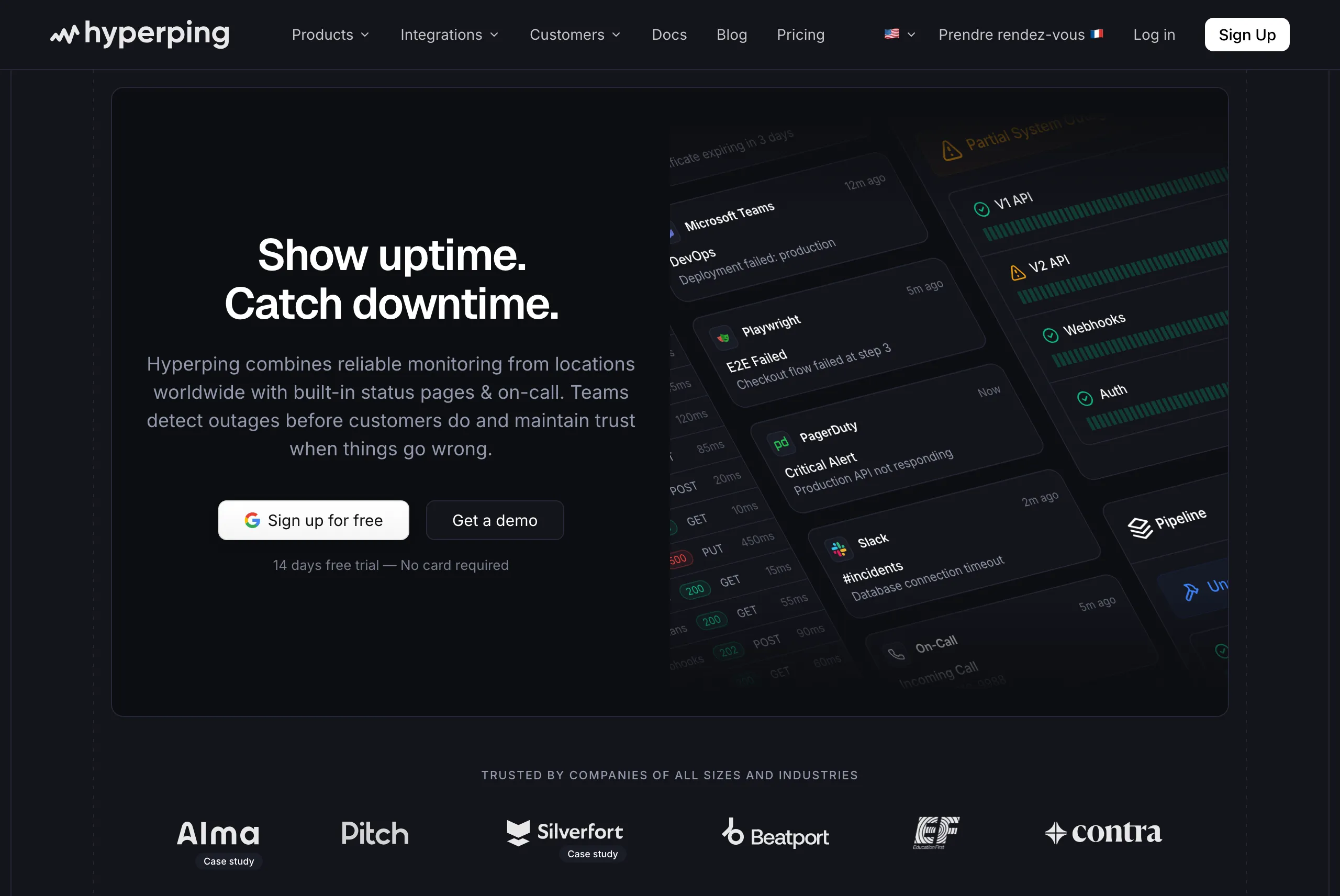
Teams that want reliable uptime monitoring, polished status pages, and on-call scheduling without complexity or budget strain. Hyperping focuses on doing the essentials extremely well rather than adding every possible feature.
From the reviews and conversations I analyzed, Hyperping appeals to teams that value simplicity and predictable pricing. It's particularly popular with European companies due to being a French company with EU hosting, and with growing SaaS teams that need more than basic monitoring but don't need full observability suites.
Notable features
- 30-second check intervals: Faster than UptimeRobot Solo's 60-second checks and matching Team's 30-second interval. UptimeRobot Scale is faster at 15 seconds. Hyperping Business is 20 seconds.
- On-call scheduling and escalation policies: Create flexible schedules with timezone-aware support, automatic rotation, and multi-step escalation. This is something UptimeRobot doesn't offer at all.
- Multiple full-featured status pages: Custom domain, white-label branding, multi-language support, and subscriber notifications. UptimeRobot Team includes 100 white-labeled pages and Scale is unlimited, so Hyperping does not win on page count.
- Browser-based synthetic monitoring: Uses Playwright for end-to-end testing of critical user flows like checkout or login processes, with video replay and trace analysis.
- Multi-channel alerting: Email, SMS, voice calls, Slack, Discord, Telegram, Microsoft Teams, PagerDuty, OpsGenie, and webhooks.
- Server monitoring: A one-line OpenTelemetry agent install collects CPU, memory, filesystem, disk I/O, and network metrics from Linux and macOS hosts, with server alerts routed through the same escalation policies as your uptime checks.
- European hosting: GDPR-compliant infrastructure with all data stored in EU data centers.
Why choose Hyperping over UptimeRobot?
Modern monitoring capabilities UptimeRobot lacks
UptimeRobot doesn't offer on-call scheduling, escalation policies, or code-based synthetic monitoring with Playwright. These are standard features in Hyperping's paid plans. Where UptimeRobot stops at "is it up?", Hyperping lets you write full Playwright tests for complex user flows and automatically route alerts to whoever is on-call.
Faster check intervals with auto-retry verification
UptimeRobot's free plan checks every 5 minutes, Solo every 60 seconds, Team every 30 seconds, and Scale every 15 seconds. Hyperping checks every 30 seconds on Essentials and Pro, 20 seconds on Business, and auto-retries failed checks from multiple regions before triggering an alert.
Predictable pricing with everything included
UptimeRobot's paid plans can feel restrictive when you need shorter intervals, more integrations, or additional features locked behind higher tiers. Hyperping's $24/month Essentials plan includes on-call scheduling, escalation policies, and a status page. No surprises.
What actual Hyperping users say
"Hyperping has been a total game-changer for us. The service is reliable, easy to use, and incredibly feature-rich. I love that it constantly checks our site and alerts us right away if there are any issues."
"We made our Hyperping status page publicly available and it became a crucial part of our sales pitches. We are proud of our uptime and we love that we can share it with prospects and customers in such an easy way."
How much does Hyperping cost?
- Essentials: $24/month for 50 monitors, 1 status page, 3 browser checks, 3 seats
- Pro: $74/month billed annually for 250 monitors, 3 public or private status pages, 10 browser checks, 10 seats. Includes email access codes, multilingual pages, and native account SAML SSO.
- Business: $249/month billed annually for 1000 monitors, 10 status pages, 20-second checks, 25 browser checks, 20 seats, priority support, and more.
All plans include on-call scheduling, escalation policies, and voice call alerts. A free tier and 14-day trial are available on all paid plans.
Where Hyperping falls short
Hyperping doesn't try to be a full observability platform. You won't get integrated log management like Better Stack or the depth of real user monitoring (RUM) that Pingdom offers. If you need to correlate logs, metrics, and traces in a single platform, you'll need additional tools.
If you're a solo developer or freelancer who only needs basic "is it down?" monitoring for personal projects, UptimeRobot's free plan is hard to beat on pure value.
Is Hyperping right for you?
Choose Hyperping if you're a startup, SMB, or growing SaaS team that wants solid monitoring, on-call scheduling, and status pages without overpaying or over-configuring. It's particularly appealing for European companies valuing GDPR compliance, teams that have outgrown UptimeRobot's basic feature set, and anyone who needs on-call scheduling and escalation policies without adding a separate tool.
Switching from UptimeRobot? Follow the migrate from UptimeRobot to Hyperping guide.
Better Stack: Best for unified monitoring, logs, and incidents
Who Better Stack is built for
Engineering teams that want uptime monitoring, log management, and incident response unified in a single platform. Better Stack works well when you want to go from "site is down" to "here's what the logs say" without switching tools.
From what I gathered in G2 reviews, Better Stack's strength is its polished developer experience. Users consistently praise the modern interface and fast setup. One reviewer described it as having "probably the best looking interface you'll ever get to work with."
Notable features
- 30-second uptime checks: Verified from at least three geographic regions to minimize false positives.
- Integrated log management: SQL-like querying with ClickHouse-powered storage, supporting up to 1 billion log lines per second.
- Incident management: On-call scheduling, escalation policies, and AI-powered post-mortems built into the same platform.
- Multi-channel alerting: Voice, SMS, Slack, Teams, email, and push notifications with noise suppression.
- Status pages: Public and private pages with branded communication.
- Playwright-based synthetic monitoring: Browser-based transaction checks for testing user flows.
Why choose Better Stack over UptimeRobot?
Unified platform replaces multiple tools
UptimeRobot only handles monitoring and basic status pages. When something goes down, you need separate tools to check logs, manage the incident, and coordinate the response. Better Stack combines monitoring, logging, and incident management so you can investigate issues from the same platform that detected them.
Modern incident response
UptimeRobot sends alerts but doesn't help you manage the response. Better Stack includes Slack-based incident management, smart incident merging to reduce alert noise, and automated AI post-mortems.
Still has a generous free tier
Better Stack offers a free plan with 10 monitors, 1 status page, and basic logging. UptimeRobot's free plan has more monitors (50), but Better Stack's free tier includes incident management features UptimeRobot doesn't have at any price.
What G2 users say about Better Stack
"BetterStack Uptime is an excellent tool for monitoring the availability of sites and services in real-time. Its interface is modern, easy to use, and pleasant on a daily basis. I appreciate the ability to quickly set up monitors, receive multi-channel alerts, and share professional status pages with clients."
"It can be quickly and easily deployed as an external monitoring tool, with a free tier available. This allows organizations to test system uptime and functionality without a significant financial commitment."
How much does Better Stack cost?
Better Stack uses modular pricing that adds up across products:
- Free tier: 10 monitors, 1 status page, limited log retention
- Monitors: $21/month per 50 additional monitors
- On-call responders: $29/month per user
- Status pages: $12/month per page + advanced addons
- Heartbeat monitors: $17/month per 10
The jump from free to paid is significant. A G2 reviewer noted: "The initial paid tier starts at $29 which is very steep for the small open source services I run. I would love to see some grace for public repos, or a lower tier around $14."
Where Better Stack falls short
Pricing that's hard to predict. The modular structure (per-monitor, per-responder, per-status-page) makes total cost difficult to estimate in advance. What starts as a free tool can quickly reach $100-200/month for a small team.
No native metrics or distributed tracing. Better Stack handles logs and uptime well, but doesn't offer the infrastructure metrics or APM capabilities of tools like Datadog.
Dashboard limitations at scale. Users managing many monitors report limited visibility, and there's no unified dashboard showing status across multiple teams.
Is Better Stack right for you?
Choose Better Stack if you want monitoring, logging, and incident management in one platform and you're comfortable with modular pricing. It's particularly strong for teams currently juggling separate tools for each function, organizations that value a modern developer experience, and teams that want to start free and grow into paid features. Be aware that costs can climb faster than expected as you add monitors, responders, and status pages.
Pingdom: Best for real user monitoring and transaction checks
Who Pingdom is built for
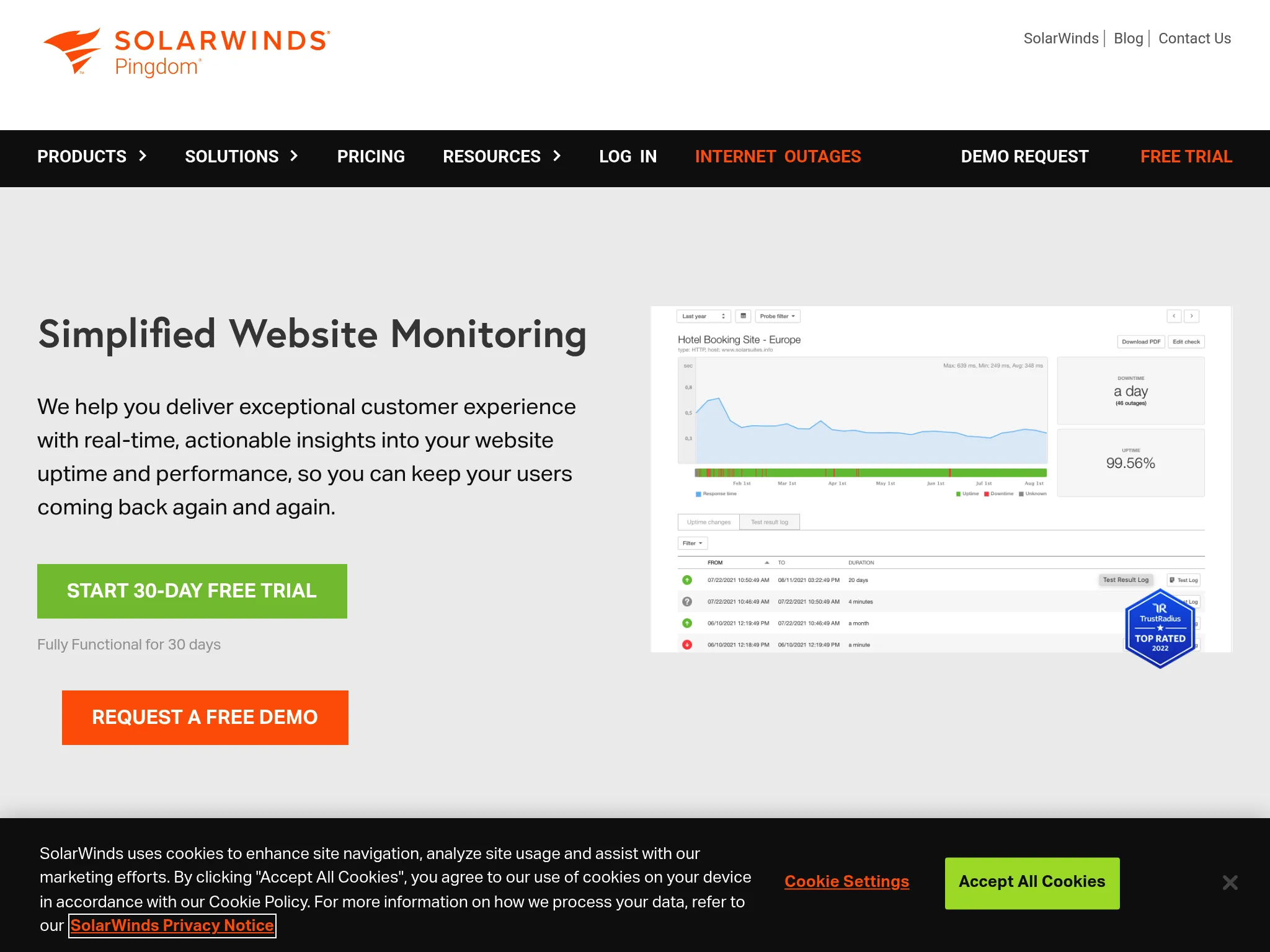
Small to mid-sized businesses, e-commerce sites, and web agencies that need both synthetic monitoring and real user data from actual visitors. Pingdom works well when you need to understand not just whether your site is up, but how real users experience it across different browsers, devices, and locations.
From what I gathered in reviews, Pingdom's strengths are its established reputation (operating since 2007, trusted by Microsoft, eBay, and GitHub), its real user monitoring feature, and its extensive network of 100+ global probe locations.
Notable features
- Real User Monitoring (RUM): Collects performance data from actual visitors, segmented by browser, device, and geography. This is something UptimeRobot doesn't offer at all.
- Transaction monitoring: Tests critical user workflows like checkouts, logins, and registrations to catch business-impacting failures.
- 100+ global monitoring locations: More probe locations than most competitors, enabling granular geographic performance data.
- Page speed analysis: Analyzes load times and identifies which elements slow down your pages.
- Multi-channel alerting: Email, SMS, push notifications, plus integrations with Slack, PagerDuty, and other tools.
- Public status pages: Communicate uptime and incidents to customers and stakeholders.
Why choose Pingdom over UptimeRobot?
Real user monitoring gives you actual visitor data
UptimeRobot checks your site from its own servers. Pingdom's RUM collects data from your actual visitors, showing you how pages load for real people on real devices in real locations. If your European users are having a different experience than US users, RUM will show that. UptimeRobot can't.
Transaction monitoring tests complete user flows
UptimeRobot can check if an endpoint returns a 200 response. Pingdom can test whether a user can actually log in, add items to a cart, and complete a purchase. For e-commerce and SaaS products, this is the difference between "site is up" and "site is working."
Broader performance visibility
Pingdom's page speed monitoring breaks down every element on your page and identifies bottlenecks. Combined with RUM, you get both synthetic and real-world performance data, a perspective UptimeRobot simply doesn't provide.
What users say about Pingdom
"Simple to use and very feature rich. Has a great dashboard for checking performance across multiple sites. The uptime monitoring is reliable and alerts are fast."
"The combination of synthetic and real user monitoring gives us a complete picture of how our sites perform for actual visitors, not just from test servers."
How much does Pingdom cost?
Pingdom uses a quantity slider, not named plans. Unlimited users on the pricing page. Figures are USD from the official calculator as of August 17, 2026:
- 10 checks: $18/month ($16.50 billed annually) for 10 uptime checks, 1 advanced check, 50 SMS
- 50 checks: $78/month ($71.50 billed annually) for 50 uptime checks, 10 advanced checks, 200 SMS
- 100 checks: $149/month ($136.42 billed annually) for 100 uptime checks, 20 advanced checks, 350 SMS
- 1,000 checks: $1,295/month ($1,186.92 billed annually) for 1,000 uptime checks, 80 advanced checks, 1,000 SMS
RUM is priced separately based on monthly pageviews, starting at $18/month for 100,000 pageviews. A 30-day free trial is listed on the customers page.
Where Pingdom falls short
Pricing escalates quickly. Crossing the 10-monitor threshold causes a sharp jump. One GetApp reviewer noted: "The price point just isn't competitive anymore, relative to the features they provide. You can't pay per-check so the moment you cross 10 your plan price nearly triples."
Outdated performance metrics. Pingdom's page speed tool still uses YSlow-based grades rather than modern Web Vitals or Lighthouse metrics.
No on-call scheduling. Like UptimeRobot, Pingdom sends alerts but doesn't manage who's on-call or how incidents escalate through a team.
Discontinued mobile apps. Pingdom removed its iOS and Android apps in 2021. You'll need to rely on email, SMS, or third-party integrations for mobile alerts.
Is Pingdom right for you?
Choose Pingdom if you need real user monitoring data to understand how actual visitors experience your site, or if transaction monitoring for e-commerce workflows is a priority. It's particularly strong for e-commerce businesses testing checkout and cart flows, web agencies managing client sites where RUM data justifies their work, and teams that need synthetic + real-user data in one platform. If pricing at scale concerns you, compare total costs carefully against alternatives like Hyperping.
Uptime.com: Best for synthetic monitoring and SLA verification
Who Uptime.com is built for
Engineering, operations, and SRE teams that need comprehensive third-party monitoring for SLA compliance and performance verification. Uptime.com works well when you need to prove uptime to customers with independent data from multiple global locations.
From what I gathered in reviews, Uptime.com's strength is its breadth of check types and focus on reducing false alerts. Users value the combination of external and private location monitoring for verifying both public-facing services and internal infrastructure.
Notable features
- 30+ check types: HTTPS, ping, DNS, SSL/cert, TCP/UDP, Whois/domain, API monitoring, transaction monitoring, page speed, heartbeat monitoring, and more. Significantly broader than UptimeRobot's monitoring types.
- No-code synthetic monitoring: Visual editor for creating transaction checks without writing scripts, testing funnels, forms, and multi-step flows.
- 80+ global monitoring locations: Plus private location probes for monitoring internal apps behind firewalls, something UptimeRobot doesn't offer.
- Advanced alerting logic: Designed to reduce false positives through configurable verification and escalation workflows.
- Status pages: Public, private, and SLA-style pages for incident communication.
- Mobile apps: Native iOS and Android apps for on-the-go monitoring.
Why choose Uptime.com over UptimeRobot?
More monitoring types in a single platform
UptimeRobot covers HTTP, ping, port, keyword, DNS, SSL, domain, and heartbeat checks. Uptime.com adds transaction monitoring, page speed analysis, RUM, and over 30 check types total. If you need more than basic uptime checks, Uptime.com covers significantly more ground.
Private location monitoring
If you need to monitor internal services behind a firewall, Uptime.com's private location probes let you do this alongside public monitoring. UptimeRobot only monitors externally.
No-code synthetic checks
UptimeRobot has no synthetic monitoring at all. Uptime.com's visual editor lets you build multi-step transaction checks (test a login flow, verify a form submission) without writing code.
What G2 users say about Uptime.com
"The flexibility of being able to create and monitor virtually anything and display the status on a self-created Status screen is what I value most. Being able to create 1-minute monitors from many different locations within the US to help identify network issues vs a real problem is an outstanding feature."
"Easy to use UI, easy to integrate, automated phone calls very effective. Customer support was very responsive, passed my feedback onto their developers, and followed up regularly with updates."
How much does Uptime.com cost?
Uptime.com recently simplified its pricing. Instead of fixed plans, you choose the number of checks and SMS alerts:
- $7/mo: 10 basic checks, 1 advanced check, 25 SMS alerts
- $30/mo: 50 basic checks, 5 advanced checks, 75 SMS alerts
- $60/mo: 100 basic checks, 10 advanced checks, 100 SMS alerts
- $600/mo: 1000 basic checks, 100 advanced checks, 1500 SMS alerts
All features are included at every tier. After 100 basic checks, pricing scales more gradually per 100 checks.
Where Uptime.com falls short
Some users report alerting delays. Capterra reviewers have noted delayed alerts and relatively low API rate limits, particularly in Terraform-heavy environments.
Limited incident management. Unlike Better Stack or Hyperping, Uptime.com doesn't include on-call scheduling or escalation policy management. You'll need a separate tool for incident response workflows.
Location attribution gaps. Some users want clearer identification of which monitoring location triggered a down report, to better distinguish regional network issues from genuine outages.
Is Uptime.com right for you?
Choose Uptime.com if you need comprehensive third-party monitoring for SLA compliance, want the broadest set of check types in a single tool, or need private location probes alongside public monitoring. It's particularly strong for SRE teams managing customer-facing SLAs, organizations needing independent uptime verification, and teams that value a visual editor for synthetic checks over code-based approaches.
Cronitor: Best for cron job and background task monitoring
Who Cronitor is built for
Engineering teams that rely heavily on cron jobs, background workers, and scheduled tasks for business-critical processes like billing, data pipelines, and backups. Cronitor works well when silent job failures could mean missed invoices, stale reports, or lost data.
From what I gathered in reviews, Cronitor's strength is making invisible scheduled processes visible. Users consistently describe it as a tool that "catches small problems before they become large ones." Trusted by teams at Johnson & Johnson, Reddit, Square, and monday.com.
Notable features
- Deep cron/heartbeat monitoring: Monitors cron jobs, background workers, Windows Scheduled Tasks, and other recurring processes using lightweight HTTP pings. Detects missing, failing, or slow jobs based on expected schedules.
- Job timing and anomaly detection: Alerts when jobs don't start, run too long, or go missing, with configurable grace periods and failure tolerances.
- Uptime monitoring: Website and API checks with frequencies down to 30 seconds on Business plans.
- Status pages: Basic, branded, and private options with subscriber notifications.
- Real User Monitoring (RUM): Basic performance analytics with first 100k events free.
- Developer-friendly setup: Jobs call a ping URL via curl/wget, with no agent installation needed. Existing crontabs can be imported automatically.
Why choose Cronitor over UptimeRobot?
Purpose-built cron job monitoring
UptimeRobot has heartbeat monitoring, but it's basic compared to Cronitor's purpose-built approach. Cronitor understands schedules: it knows when a job should run, how long it should take, and alerts when anything deviates. UptimeRobot's heartbeat checks confirm a signal was sent but lack the schedule awareness and timing analysis Cronitor provides.
RUM included
Cronitor includes basic Real User Monitoring with the first 100k events free. UptimeRobot doesn't offer RUM at any tier.
What users say about Cronitor
"We monitor numerous automated processes with Cronitor, and it has helped us catch small problems before they became large ones."
"We highly recommend it, especially for smaller companies without dedicated DevOps teams. Allows a relatively small IT team the ability to monitor a variety of different systems and processes, both on-prem and cloud-based."
How much does Cronitor cost?
- Free (Hacker): 5 monitors, basic cron/heartbeat + website monitoring, basic status page, 5-minute check frequency, 1 user
- Business: Pay per monitor ($2/monitor), 30-second checks, additional users ($5/user/month), advanced status pages and SSO available as add-ons
- Enterprise: Custom pricing, 5-second checks, advanced SSO/SCIM, dedicated support
A 14-day free trial is available on all paid plans.
Where Cronitor falls short
Per-monitor pricing adds up. Users with many monitors find costs climbing quickly. One Capterra reviewer noted: "Recently there was a pricing change. This change might be good for people with only a few crons, but if you have many crons, it might not be ideal, since the cost is now based on the number of crons you have."
No on-call scheduling or escalation policies. Cronitor routes alerts but doesn't manage who's on-call or how incidents escalate through a team. You'll need a separate tool for that.
No voice call alerts. Unlike Hyperping and Better Stack, Cronitor doesn't offer phone call alerts for critical incidents.
Schedule exception limitations. Users monitoring semi-manual processes report difficulty with schedule tolerance settings. One reviewer noted: "There is no support for exceptions in scheduled (e.g. every day at 9am except for weekends)."
Is Cronitor right for you?
Choose Cronitor if your infrastructure depends on cron jobs, background tasks, and scheduled processes that need to run reliably. It's particularly strong for SaaS companies with critical billing and ETL jobs, teams wanting cron + uptime + status pages in one tool, and smaller engineering teams that need quick setup without specialized DevOps expertise. If you have hundreds of monitors, evaluate total cost carefully before committing.
Open-source alternative: Uptime Kuma
If you need a self-hosted option, Uptime Kuma offers the best balance of features and ease of use among open-source monitoring tools. It provides a polished UI, multiple notification channels, and supports HTTP, TCP, DNS, and other check types.
The tradeoff: you become the single point of failure. If your monitoring server goes down, you won't know when your services go down either. There's no global probe network to verify outages from multiple locations. For most teams, the reliability and support of managed services outweigh the cost savings of self-hosting. For a direct comparison on cost, regions and upkeep, read UptimeRobot vs Uptime Kuma.
Other open-source alternatives include Nagios, Upptime, CState, and Kener, but these generally require more technical expertise to set up and maintain.
All UptimeRobot alternatives analyzed
For completeness, here's the full landscape of alternatives beyond our top picks:
| Name | Pricing (2026 Est.) | Main Strength | Main Weakness |
|---|---|---|---|
| Hyperping | From $24/mo | Predictable pricing. 30-second checks, status pages, Playwright tests, on-call scheduling with seats included. | Not full observability. No integrated log management or APM. |
| Better Stack | Free; paid from $29/mo | Unified platform. Monitoring + logs + incidents with modern interface and fast setup. | Pricing jumps. Modular pricing adds up quickly from free tier. |
| Pingdom | From $18/mo | RUM + transactions. Real user monitoring with 100+ global probes and transaction checks. | Pricing at scale. Costs jump sharply past 10 monitors. |
| Uptime.com | From $7/mo | Breadth of checks. 30+ check types, private location probes, strong SLA reporting. | No incident management. Needs separate on-call and escalation tools. |
| Cronitor | Free; from $7/mo | Cron monitoring. Purpose-built for scheduled tasks with uptime + status pages bundled. | Per-monitor pricing. Costs climb with high monitor counts. |
| Datadog | $15/host/mo + usage | Deep observability. Metrics, logs, traces, APM correlated to the line of code. | Cost complexity. Log ingestion and custom metrics create unpredictable bills. See the Datadog alternative comparison. |
| New Relic | Free tier; $49/user/mo Core, $549 full platform | Transparent user pricing. Free tier included, and Core seats cover a restricted set of the platform. | Steep learning curve. Costs escalate with data ingestion. See the New Relic alternative comparison. |
| Site24x7 | From ~$9/mo | Value for money. Massive feature set (RUM, APM, server, network) at low price. | Dated UI. Interface is cluttered and difficult to navigate. |
| StatusCake | Free; $24.49/mo | Page speed monitoring. Includes Lighthouse performance data in standard plans. | Slower development. Users report less frequent feature updates. See the StatusCake alternatives guide. |
| Checkly | Free; $24/mo | Programmable synthetics. Playwright-based E2E testing in CI/CD pipelines. | Requires coding. Not suitable for non-technical users. |
| Uptime Kuma | Free (self-hosted) | Self-hosted freedom. No subscription costs with a polished UI. | You're the SPoF. No global probe network, you maintain everything. |
| Pulsetic | Free; $19/mo | Beautiful UI. Polished status pages and badges at a low price. | Limited depth. Lacks advanced incident management and on-call. |
| Instatus | Free; $20/mo | Status page focus. Unlimited subscribers, beautiful static pages at low cost. | No monitoring. Purely a communication tool, needs external webhooks. |
| Atlassian Statuspage | Free; $300-$1,499/mo | Jira ecosystem. For existing Atlassian/Opsgenie users. | Expensive private pages. Private status pages start at $300/month. |
| Freshping | Budget-friendly | Most affordable. Essential monitoring features at lowest price point. | Limited features. Sacrifices advanced functionality for cost savings. |
| Grafana Cloud | Free; usage-based | Visualization. Top-tier dashboarding and data correlation. | Complexity. Steep learning curve (PromQL/LogQL), needs DevOps expertise. |
| Dynatrace | $0.04/hour per 8 GiB host | AI automation. Auto-discovery with real-time vulnerability analysis. | Premium pricing. Steep setup, overkill for smaller teams. |
| SolarWinds NPM | Enterprise pricing | Network monitoring. Deep network and infrastructure visibility. | Complex setup. Enterprise-focused, heavy configuration required. |
| ThousandEyes | Enterprise pricing | Internet intelligence. Maps performance across ISPs and cloud providers. | Enterprise only. Complex and expensive for simple monitoring needs. |
How to test these tools
All five top picks offer trials or free tiers:
- Hyperping: Free tier and 14-day trial on all paid plans
- Better Stack: Generous free tier with monitoring, logging, and status pages
- Pingdom: 14-30 day free trial with full features
- Uptime.com: Plans start at $7/month with all features included
- Cronitor: Free tier with 5 monitors plus 14-day trial on paid plans
Switching to Hyperping? Follow the migrate from UptimeRobot to Hyperping guide before you run the steps below.
To evaluate them:
- Sign up for 1-2 free tiers that match your primary use case.
- Run the new tool alongside UptimeRobot for at least one week to compare detection accuracy and false positive rates.
- Test the alerting workflow end-to-end: Does the alert reach the right person, through the right channel, fast enough?
- Evaluate status pages if you use them: do they look professional, support custom domains, and integrate with your monitoring?
- Compare total cost at your expected scale, not just the starting price.
Related reading
- Migrate from UptimeRobot to Hyperping — step-by-step migration guide
- Pingdom vs UptimeRobot vs Hyperping — head-to-head comparison
- Best uptime monitoring software — broader monitoring tool roundup
- Linux server monitoring guide: CPU, memory, disk, and network monitoring on your hosts
- Uptime monitoring hub: all our monitoring resources
FAQ
Is UptimeRobot still worth using in 2026? ▼
UptimeRobot remains a solid choice for basic uptime monitoring, especially for personal projects and small-scale commercial use. Its free plan with 50 monitors is still the most generous in the category. But if you need synthetic monitoring, on-call scheduling, or detailed performance analytics, you'll find it limiting. Teams with growing complexity tend to supplement UptimeRobot with other tools or switch to a more complete platform.
How much does UptimeRobot cost compared to alternatives? ▼
UptimeRobot's free plan offers 50 monitors with 5-minute checks. Paid Solo starts at $12/month billed annually for 10 monitors with 60-second checks. Team is $39/month billed annually for 100 monitors with 30-second checks. Hyperping offers 50 monitors for $24/month with 30-second checks, on-call scheduling, and status pages included. Uptime.com starts at $7/month for 10 checks with all features included. The price difference depends on what features you need beyond basic monitoring.
Can I migrate from UptimeRobot easily? ▼
Yes. Hyperping's migration guide walks through exporting UptimeRobot monitors via API, recreating them in Hyperping (API or Terraform), running both tools in parallel, and cutting over. The team also offers free white-glove migration on paid plans. See /docs/migrate/from-uptimerobot.
Which UptimeRobot alternative is best for small teams? ▼
Hyperping for teams that need monitoring, on-call scheduling, and status pages in one tool ($24/month). Cronitor for teams whose main concern is cron job monitoring ($7/month). Uptime.com for teams that need the broadest set of check types at the lowest entry price ($7/month for 10 checks).
Which UptimeRobot alternative is best for enterprises? ▼
Better Stack if you want monitoring + logs + incidents unified. Datadog if you need full-stack observability across complex distributed systems. Both handle enterprise scale, though pricing requires careful management.
What about UptimeRobot's free plan? Is there a free alternative with more features? ▼
UptimeRobot's free plan (50 monitors, 5-minute intervals) is the most generous free tier for pure uptime monitoring. Better Stack offers a free tier with 10 monitors but adds incident management and logging. Cronitor's free plan includes 5 monitors with cron job monitoring. Hyperping has a free tier with 20 monitors and 30-second checks. None match UptimeRobot's 50 free monitors, but they offer features UptimeRobot doesn't at any price.