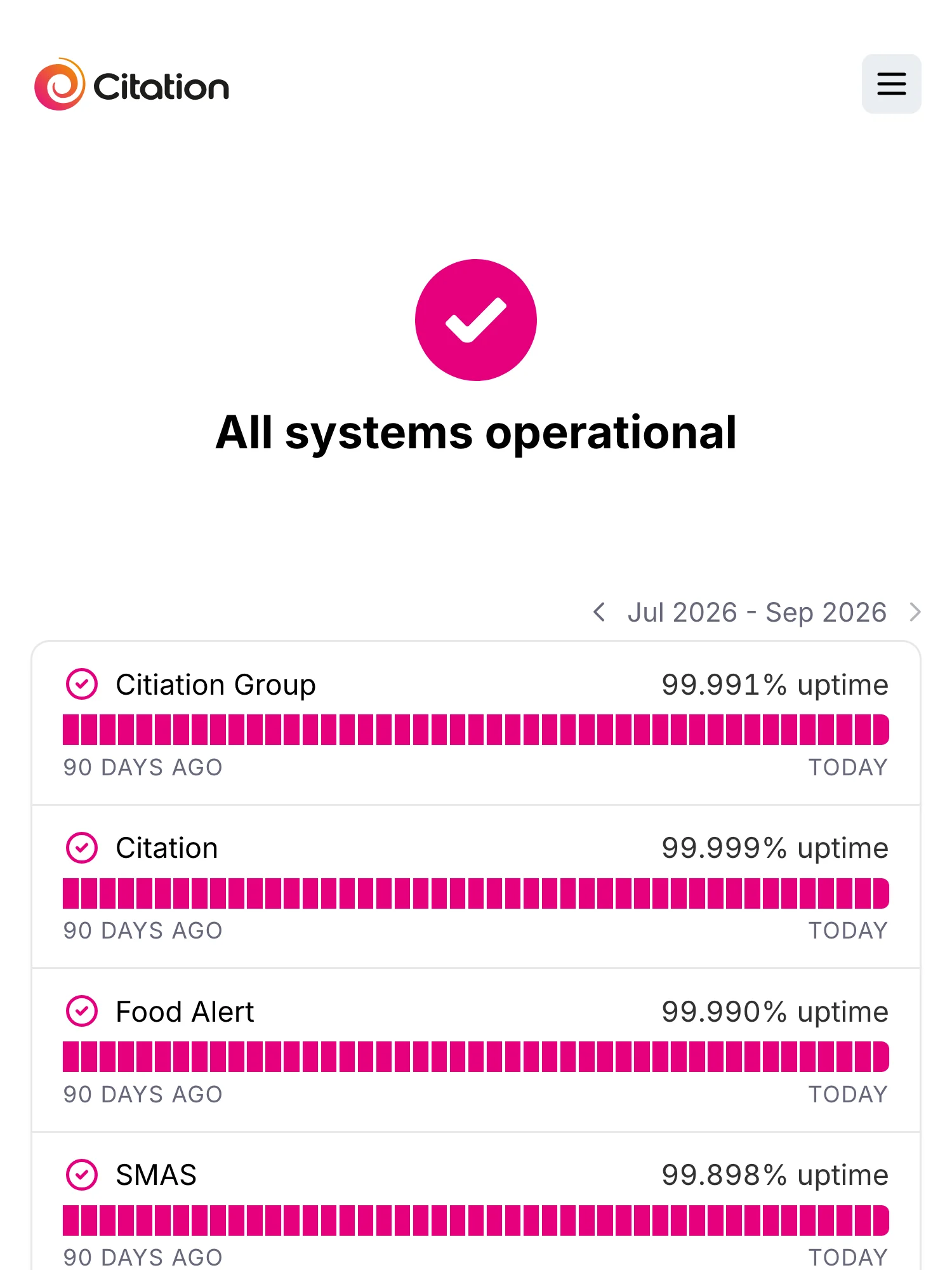
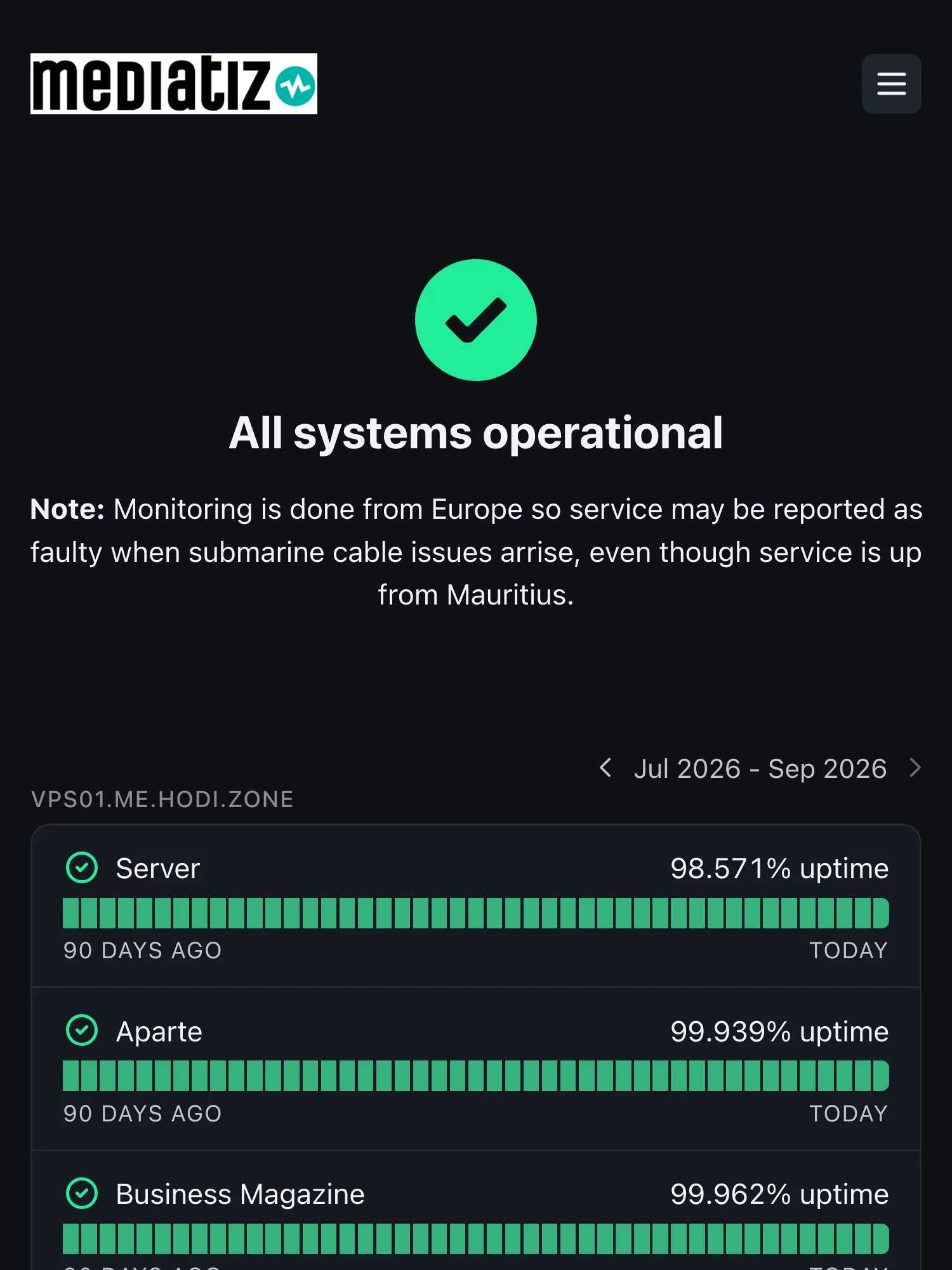
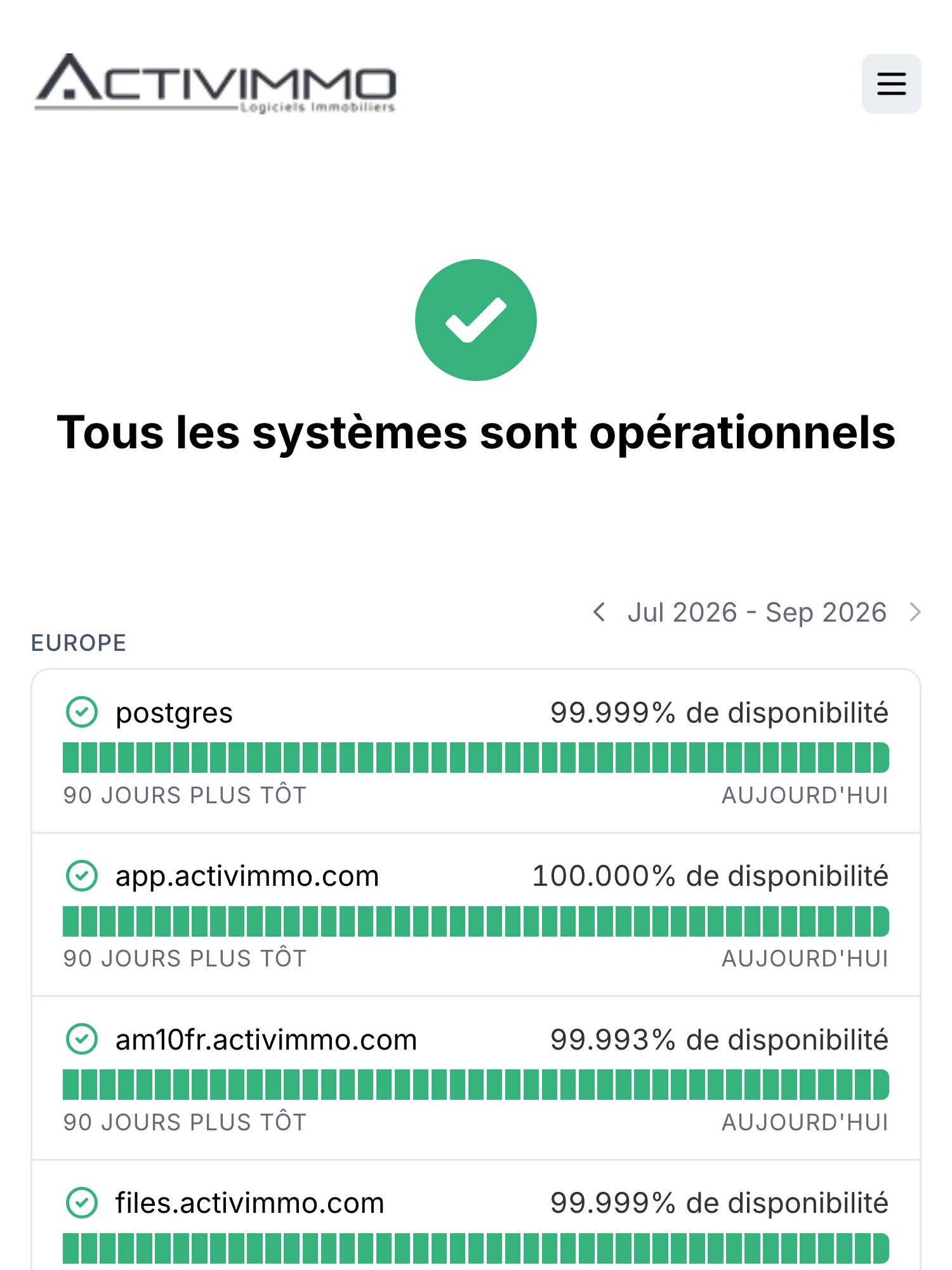
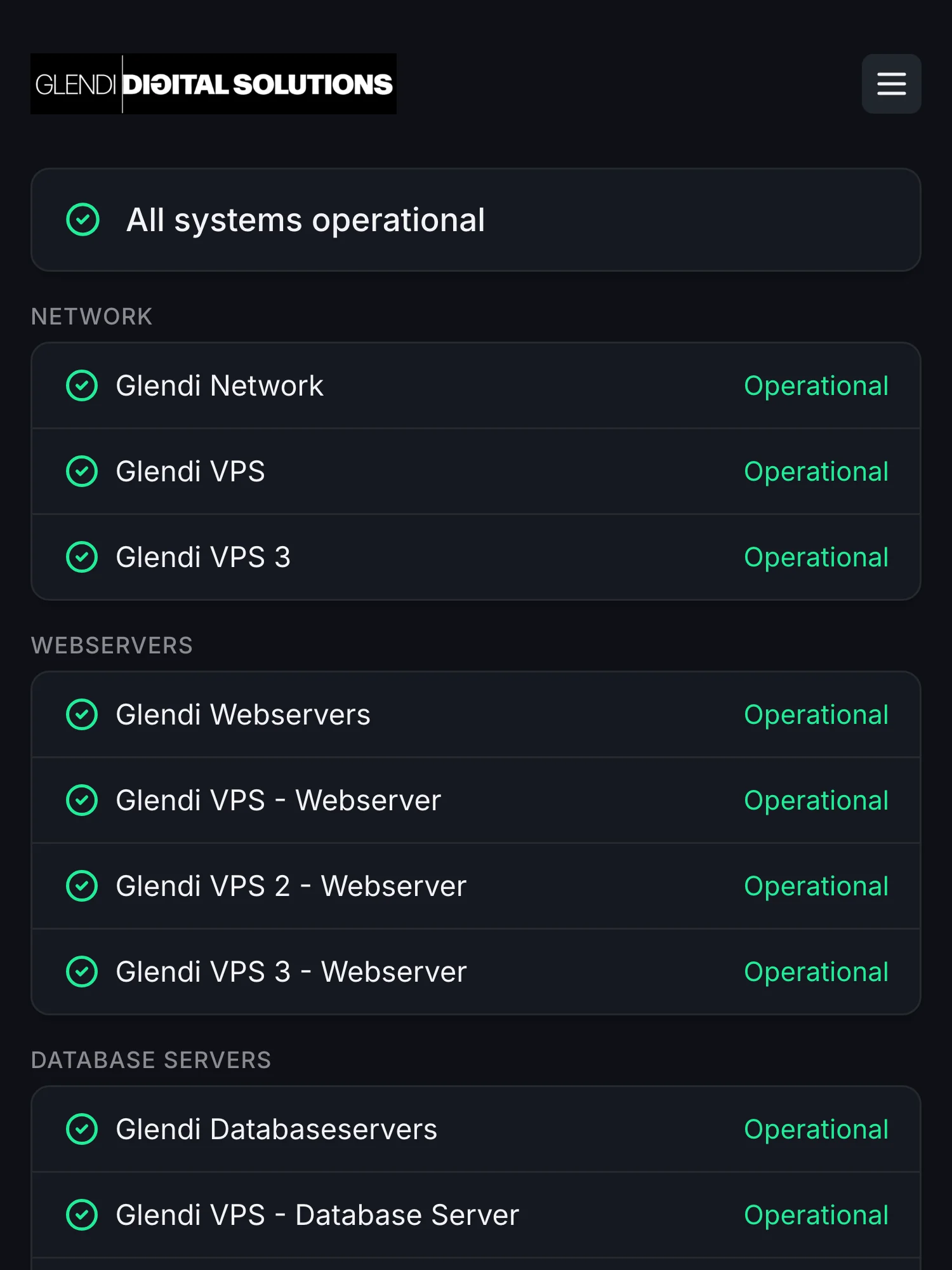
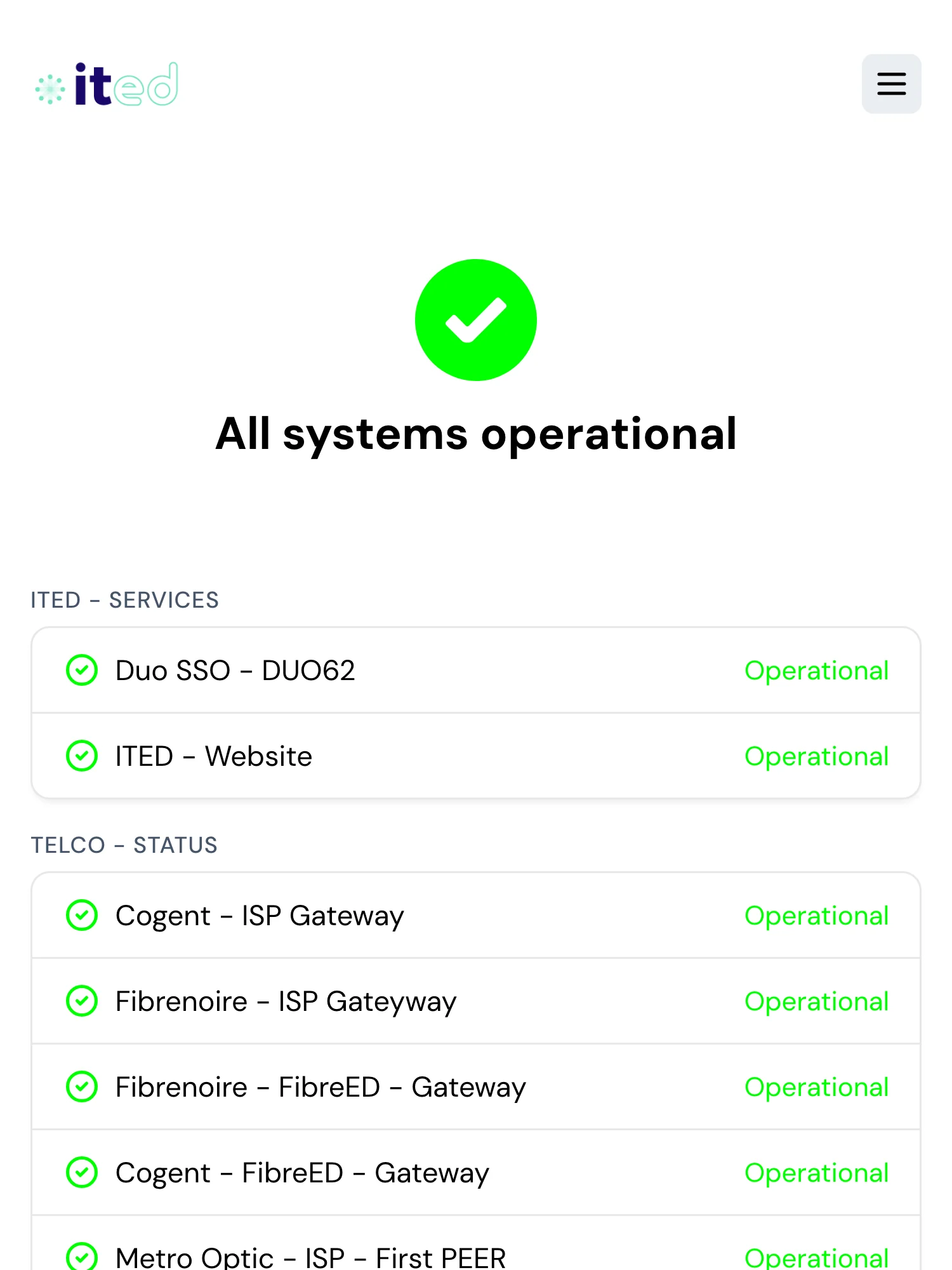
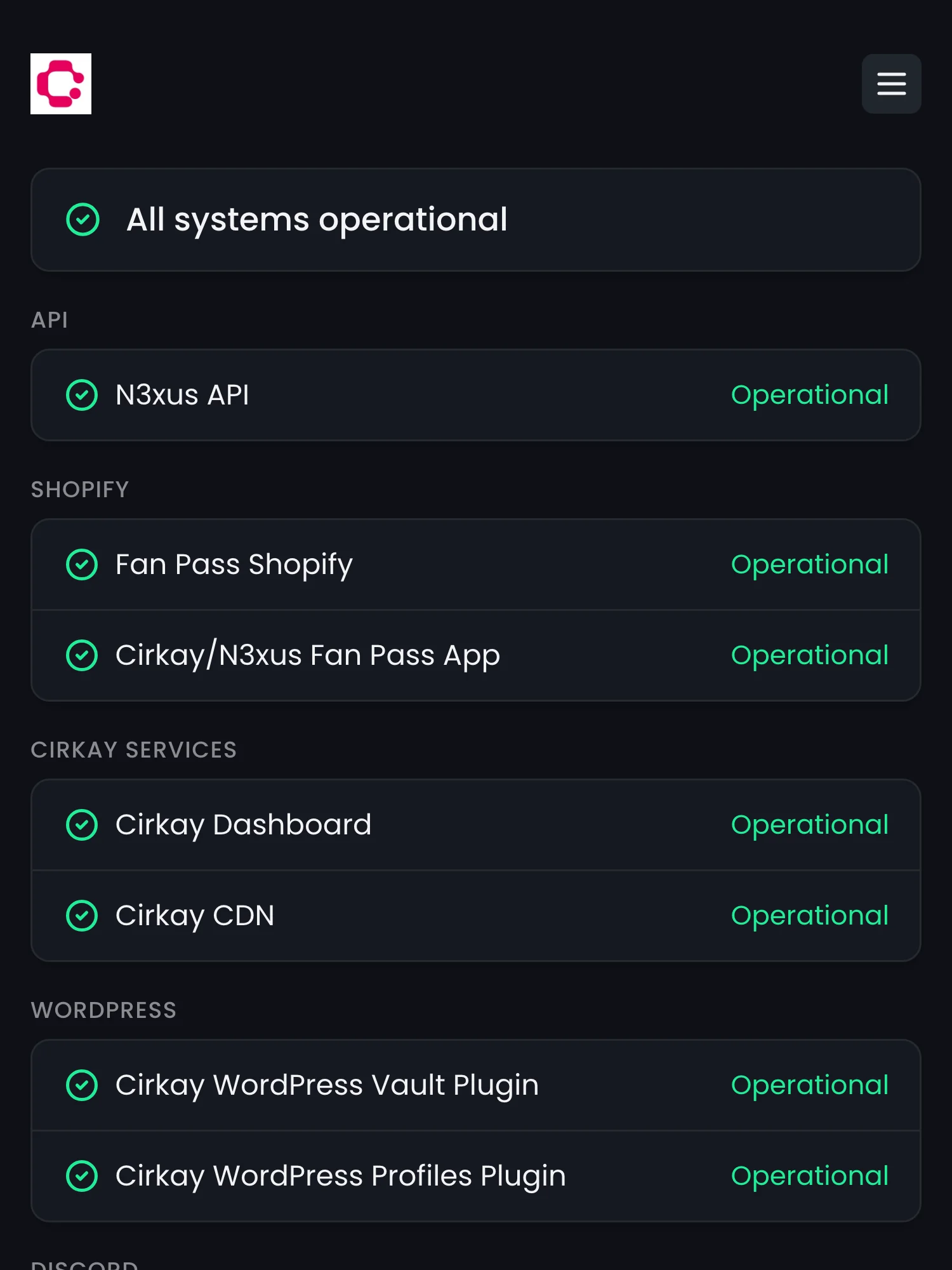
A page in each client’s colors
Every client gets a status page on their own domain, with their logo, colors and font. On Business, drop the Hyperping footer and send updates from their domain.
See white labelingMonitoring and status pages for agencies. Watch every client site from one account, and hear about outages before your clients do.
20 monitors free. No credit card required.
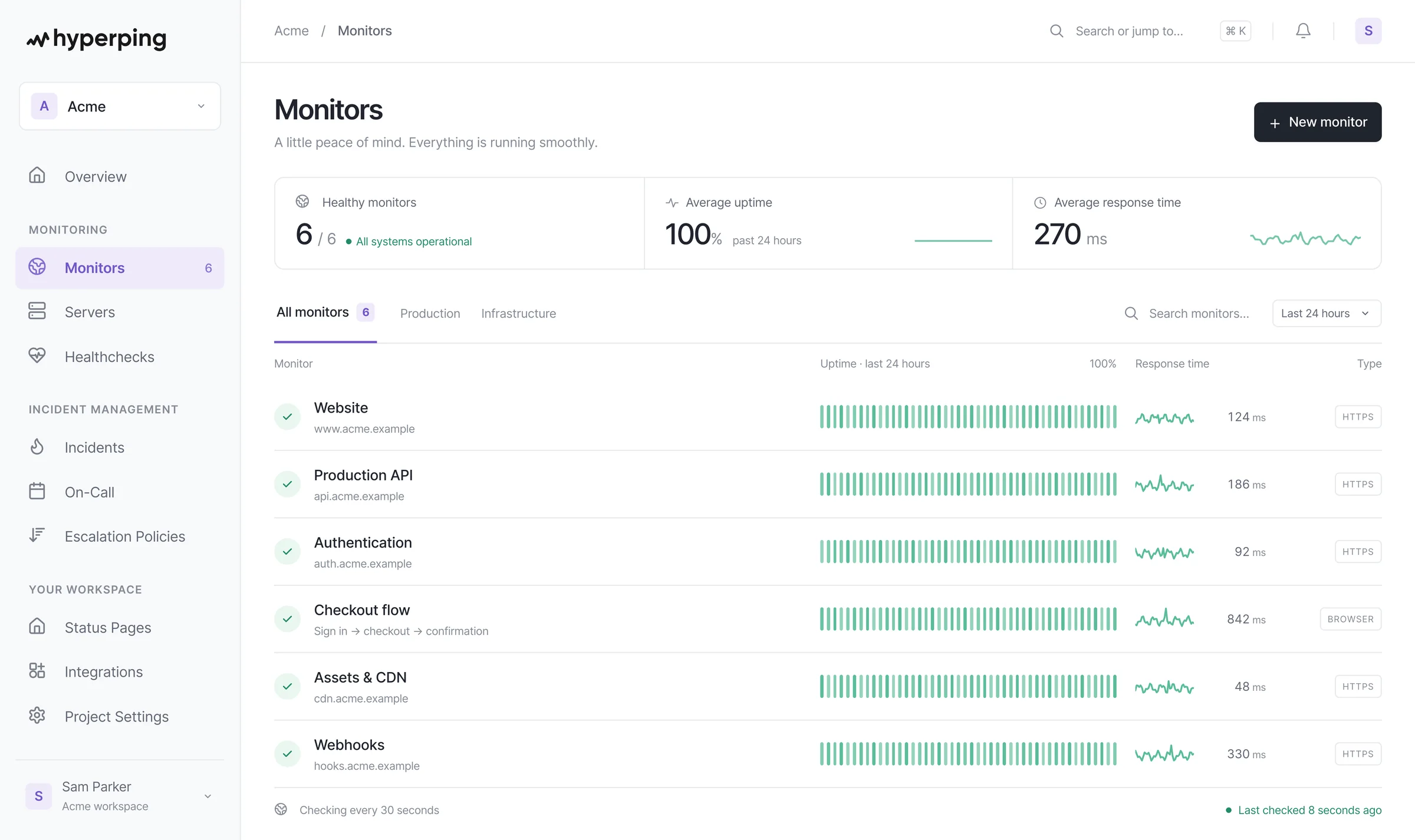
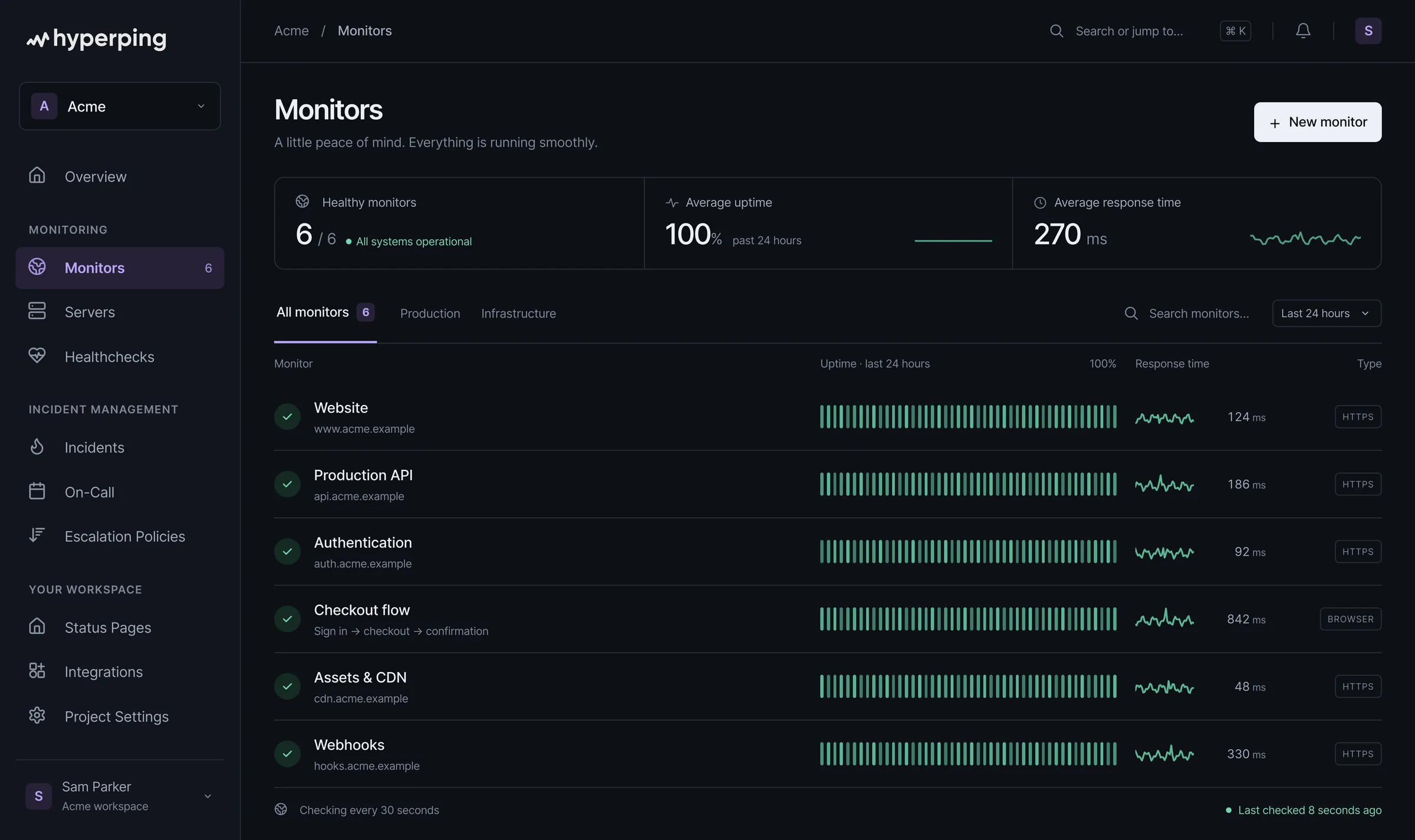















Each client site is checked every 30 seconds on paid plans, from the regions you pick among 18. When one goes down, the alert reaches that client’s Slack channel or your on-call engineer before the client picks up the phone.
Uptime monitoringEvery HTTPS monitor checks its certificate chain and reminds you 30 days before expiry, on every client site you watch. No spreadsheet of renewal dates to keep.
SSL monitoringDNS monitors check the records each client site depends on, against the answer you expect. When a registration lapses or someone edits a record, the check fails as soon as it stops resolving as it should.
DNS monitoringA working homepage says nothing about the cart. Browser checks run the real path in Playwright, add to cart, pay, send the form, and each failed run comes with a screenshot, a video and a trace.
Browser checksThe reporting dashboard gives uptime, outages, longest downtime, MTTR and MTTA over the period you pick. Export it as CSV and attach it to the client’s monthly report.
ReportsSchedule the plugin updates or the server move once: the window shows on the client’s status page, pauses the monitors it touches so nobody is paged, and notifies subscribers ahead of time.
Maintenance windowsEvery client gets a status page on their own domain, with their logo, colors and font. On Business, drop the Hyperping footer and send updates from their domain.
See white labelingKeep internal services for the client’s staff: protect the page with a password or email access codes on Pro, or Google SSO and SAML SSO on Business.
Explore private status pagesHTTP and keyword checks on every site, Playwright runs through checkout, certificate reminders and DNS checks. Each confirmed outage updates the right component on the client’s page.
Explore uptime monitoringEvery alert is double-checked from at least two other locations before it reaches the tools your team already uses.
 Slack
Slack Microsoft Teams
 Google Chat
 PagerDuty
 Opsgenie
 Jira Service Management
 Discord
 Telegram
 Mobile app
USD · Monthly billing for every plan
Three subscriptions to keep it all running.
$747/month
$8,964 over 12 months
Everything connected, from the first check.
$299/month
$3,588 over 12 monthsSave $5,376 a year with this mix.
Reviewed . All amounts are USD; local currency prices may differ.
This is one example of a three-tool stack, not the cheapest possible setup or a feature-for-feature match. Pingdom and PagerDuty also include status-page features; a separate Statuspage subscription may not be needed by every team. Usage charges and paid connectors are not included. Annual totals are 12 monthly payments, not annual subscription quotes.
Yes. Each status page has its own domain, logo, colors, components and subscribers. Pro includes 3 status pages and Business 10, each on a custom domain with an SSL certificate we issue and renew for you. Above 10 clients, talk to sales.
Yes, on Business. White labeling hides the “Powered by Hyperping” footer and sends subscriber emails from a domain you verify. Logo, colors and fonts are yours to set on every plan.
Yes. Create one project per client: monitors, status pages, alert channels and maintenance windows stay inside it. A teammate invited to a project sees only that project, and only the account owner sees them all. Seats are shared across projects: 3 on Essentials, 10 on Pro and 20 on Business, with extra seats billed per user.
Yes. Slack, Microsoft Teams, Discord and webhooks are set per project, so each client’s alerts land in their own channel. Escalation policies, assigned per monitor, decide who is paged and when, including phone calls and on-call schedules.
Yes. The reporting dashboard shows uptime, outages, total and longest downtime, MTTR and MTTA over the period you pick. Export it as CSV for a client’s monthly report or SLA review. Reports and CSV export start on Essentials, and every plan gets a weekly summary by email.
Yes, for both. Every HTTPS monitor checks its certificate daily and reminds you before it expires, up to 90 days ahead, until it’s renewed. Domain expiry alerts read the registration date from the registry and warn you before it lapses, once per domain however many monitors point at it. See SSL monitoring and domain expiry monitoring.
Yes. Create monitors through the API, manage them as code with the Terraform provider, or ask Claude or Cursor to add them through the MCP server. The API is available on all paid plans.
Pro covers 3 clients with a page each, 250 monitors and 10 seats. Business covers 10, with 1,000 monitors, 20-second checks, white labeling and 20 seats. See what 5 and 10 white-label pages cost against Better Stack and Statuspage on status pages for agencies, and every limit on the pricing page.