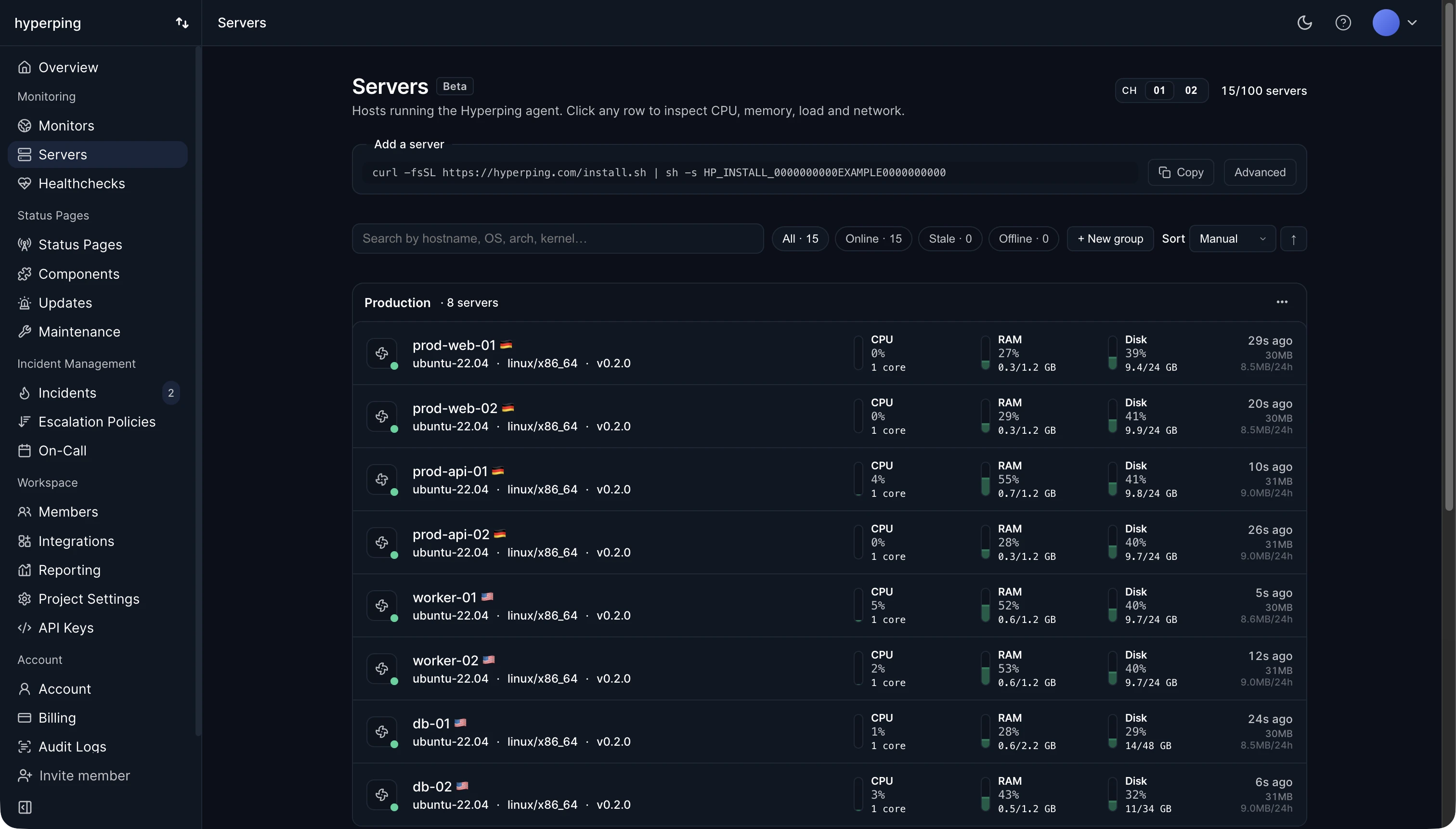
Hyperping's server agent installs with a single command on Linux (systemd) and macOS (launchd), on amd64 and arm64, and on Windows (as a Windows service) on amd64. It holds around 50 MB of memory with no JVM, makes only outbound HTTPS requests, and queues metrics on disk so they survive an ingest outage or a reboot. Re-running the installer rotates its credentials while keeping the same server identity and history.
Agent-based vs agentless monitoring
Agentless approaches read a machine from outside: SNMP polling, SSH scraping, or the cloud provider's metrics API. They need nothing installed, but they see less. Cloud APIs don't report memory or per-filesystem space, and SSH scraping adds credentials and load of its own.
An agent can read /proc, list mount points, and count bytes per block device. It also keeps recording when the network path to the monitoring service is what broke, as long as it buffers locally.
The costs of an agent
- It's software you install, upgrade, and hold credentials for on every host.
- It uses memory and CPU on machines that run your workload.
- Its own liveness has to be watched, because a silent agent looks exactly like a quiet, healthy server.
The last point is the one teams forget. In Hyperping, a server that stops reporting is marked Stale after 30 seconds and Offline after 90 seconds by default, which opens an outage and pages its escalation policy.
Choosing an agent
Judge one on four things: its resident memory footprint, whether it queues to disk during an ingest outage, whether it needs inbound ports, and how painful credential rotation is across a fleet. An agent that needs a firewall change on every host, or loses data whenever the vendor has an incident, costs more than it looks.
FAQ
Does a monitoring agent slow down the server?
A well-built one barely does. Hyperping's agent targets about 50 MB of memory and scrapes every 30 seconds. Check the footprint of any agent before installing it on small instances.
Can I install the agent with Ansible or Terraform?
Yes. The install command takes the server's name, escalation policy, and group, so fleet tools and Kubernetes DaemonSets can set them at install time. See install the agent.
Do I still need uptime monitoring with an agent?
Yes. The agent reports from inside the host. An external check is what tells you users can reach the service through DNS, TLS, and the network.