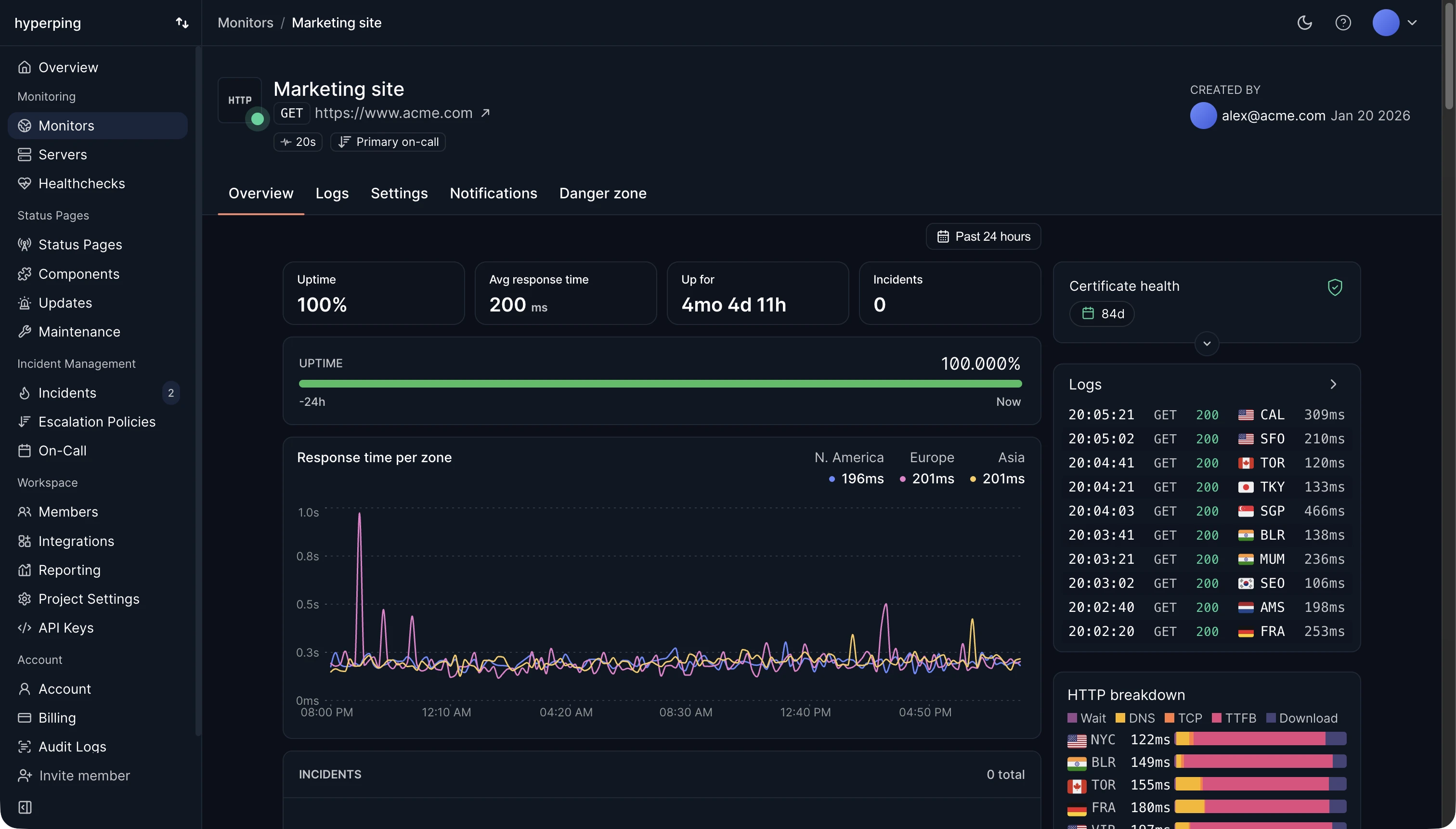
An SLA is only as good as the measurement behind it, and the customer has to be able to check it. Most providers measure uptime with an external monitor such as Hyperping, which checks each service from several regions, counts only failures confirmed from more than one region as downtime, and reports uptime per monitor over any period. The same numbers can go on a public status page, so customers see the record the SLA is judged on.
Parts of an SLA
- The target, such as 99.9% or 99.95% availability.
- The measurement period, almost always a calendar month.
- A definition of downtime: which services, which errors, and how long a failure must last before it counts. Many SLAs ignore failures shorter than one to five minutes.
- Exclusions, typically scheduled maintenance announced in advance, customer-caused problems, and force majeure.
- The remedy, usually service credits: a percentage of the monthly bill, rising as uptime falls further below the target.
- How to claim. Most SLAs make the customer request credits within 30 days, with evidence.
SLA, SLO, and SLI
The three describe the same target at different levels of commitment. The SLI (service level indicator) is the measurement, such as the share of checks that passed over the last 30 days. The SLO is the internal goal you hold that measurement to. The SLA is the promise you put in a contract, with money attached.
Set the SLO tighter than the SLA. If you promise customers 99.9%, aim for 99.95% internally, so you notice the slide and react before it costs you credits. The gap between the two is your safety margin.
Downtime allowed by common SLA targets
- 99%: 7 hours 12 minutes per 30-day month, 3.65 days per year.
- 99.9%: 43 minutes 12 seconds per month, 8 hours 45 minutes per year.
- 99.95%: 21 minutes 36 seconds per month, 4 hours 22 minutes per year.
- 99.99%: 4 minutes 19 seconds per month, 52 minutes 34 seconds per year.
- 99.999%: 26 seconds per month, 5 minutes 15 seconds per year.
The SLA calculator converts any percentage into downtime per day, week, month, and year.
How to choose an SLA target
Promise what you already deliver, not what you hope to. Look at your measured uptime over the last six to twelve months and set the SLA below your worst month. A first SLA at 99.9% is a safe default for most SaaS products: it leaves room for one bad incident a month without paying credits.
Check your dependencies too. Your SLA can't be higher than the availability of the cloud region, database, and payment provider you depend on, unless you have a fallback for each of them.
How to track an SLA with Hyperping
- Create a monitor for each service the SLA covers, with regions close to your customers.
- Schedule maintenance windows for planned work, so excluded maintenance is announced on your status page.
- Open the reporting dashboard at the end of each month to read uptime, outages, and total downtime per monitor, and export them to CSV for the SLA review.
- Pull the same numbers from the Reports API if you calculate credits automatically.
FAQ
What is a good SLA percentage?
99.9% for most SaaS products, 99.95% or 99.99% for infrastructure other companies build on. Above 99.99% you need redundancy in every layer, and the monthly budget is too small to absorb a single slow rollback.
What happens when an SLA is breached?
The customer can claim the credits the contract defines, usually 10% to 30% of the monthly fee depending on how far uptime fell. Repeated breaches often give the customer the right to terminate.
Does scheduled maintenance count against an SLA?
Usually not, as long as it was announced in advance, often 48 hours or more. Write the notice period into the SLA and announce maintenance on your status page so there is a record.
What is the difference between an SLA and an uptime guarantee?
An uptime guarantee is one clause of an SLA. A full SLA can also cover response times, support response times, and data durability.