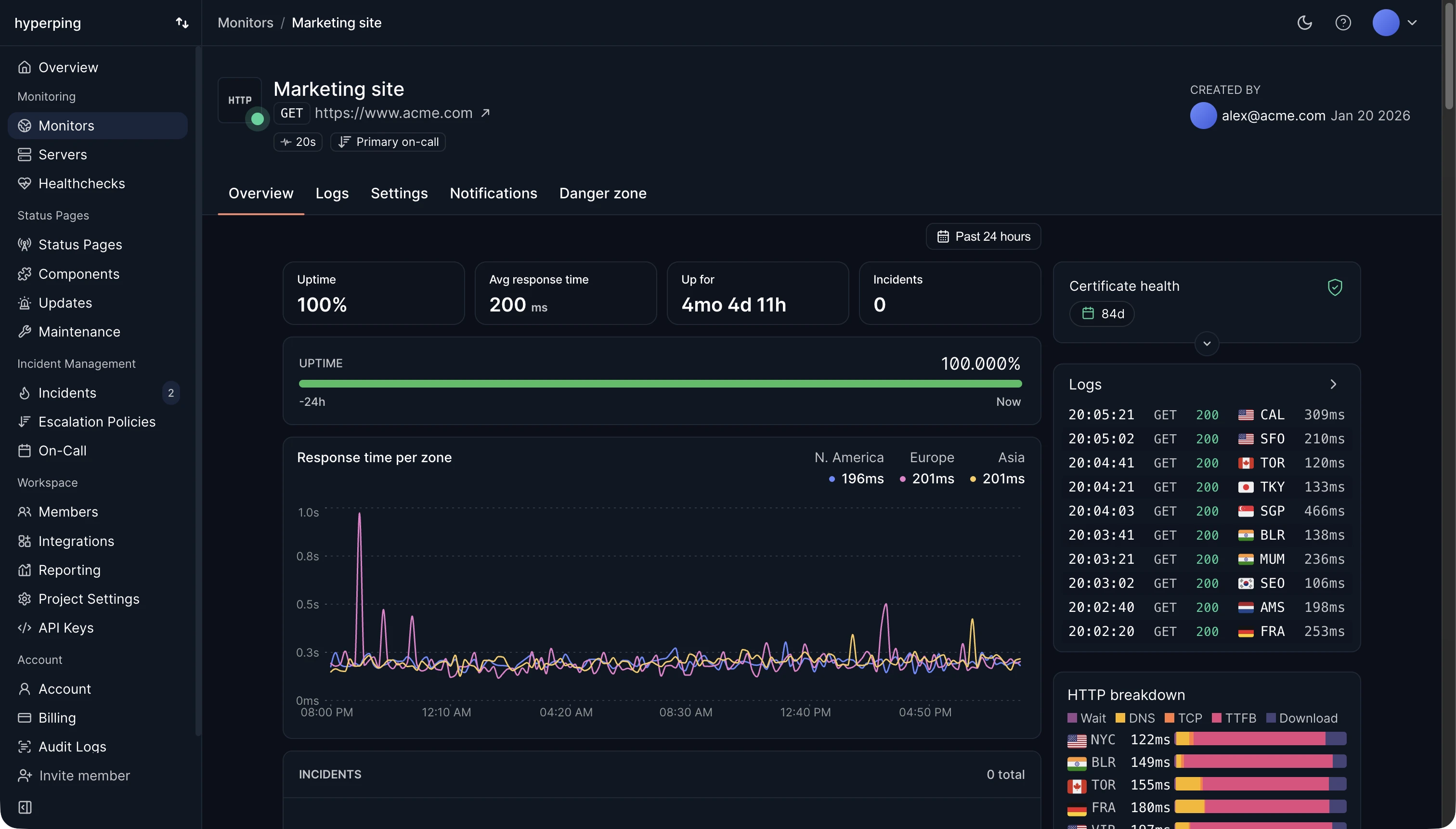
Verifying five nines is hard in itself. A monitor checking every 5 minutes can miss a 3-minute outage completely, and that outage alone is more than half the yearly budget. Hyperping checks as often as every 30 seconds, with shorter intervals on the Business plan, from up to 18 regions, and records the start and end of each confirmed outage, so the uptime number reflects every incident rather than the ones a slow check happened to catch.
Downtime allowed at each level
- 99.9% (three nines): 8 hours 45 minutes per year, 43 minutes 12 seconds per month.
- 99.99% (four nines): 52 minutes 34 seconds per year, 4 minutes 19 seconds per month.
- 99.999% (five nines): 5 minutes 15 seconds per year, 26 seconds per month.
- 99.9999% (six nines): 32 seconds per year.
Each level has its own page with daily, weekly, and monthly figures: three nines, four nines, five nines, and six nines.
Requirements for five nines
At 26 seconds a month, no human is fast enough to be part of the recovery. Everything has to fail over on its own:
- Redundant copies of every component, in more than one region, with automatic failover that finishes in seconds.
- Deploys that never take the service down: rolling, canary, or blue-green releases with automatic rollback.
- Dependencies that are themselves above five nines, or a fallback for each one. A single DNS provider or database primary makes the target impossible.
- Regular failure testing, so failover is known to work before it's needed.
The jump from four nines to five usually costs far more than the jump from three to four, for 47 minutes a year of difference.
Do you need five nines?
Probably not. Most SaaS products and websites are well served by 99.9% to 99.95%. Your users' own internet connections, Wi-Fi, and mobile networks fail more often than that, so they can't tell 99.99% from 99.999%. Spend the extra effort on faster recovery and better communication during incidents, which users do notice.
Five nines makes sense where a few minutes of outage has real consequences beyond lost sales: emergency services, payment networks, and the infrastructure other companies build their own SLAs on.
FAQ
How much downtime is five nines per year?
5 minutes 15 seconds per year, or 5.26 minutes. Per 30-day month it's about 26 seconds, and per day less than a second.
Which companies offer five nines?
Few offer it as an SLA across a whole service. Cloud providers reach it on narrowly defined components, often only for multi-region setups. Read the definition of downtime in the SLA: five nines on a single storage API is very different from five nines on an entire product.
Is five nines the same as high availability?
High availability is the design approach (redundancy and automatic failover). Five nines is one target that design can aim for. Many high-availability systems target 99.99%.