If you're stuck between Better Stack vs Uptime.com vs Hyperping, consider Better Stack if you need all-in-one observability (monitoring + logging + incident management). Uptime.com for enterprise-grade monitoring. Hyperping for the best of both worlds without complexity.
In this guide, you'll learn:
- Core features, pricing, and hidden costs to watch for
- Which tool fits your team size and infrastructure complexity
- Real user experiences from hands-on testing and hundreds of analyzed reviews
- Common pain points: cost uncertainty, feature overload, alert fatigue, and missing capabilities
- How each platform handles these challenges differently
If you want monitoring that catches issues in 30 seconds, status pages that strengthen customer trust, and pricing you can actually predict, Hyperping delivers exactly that. Get in touch with us to schedule a demo of Hyperping.
Why you should trust this guide
I'm Léo, founder of Hyperping. Yes, that means I have a stake in one of these tools. But I've seen teams choose competitors when they were genuinely the better fit. My goal isn't to convince you Hyperping is always the answer. It's to help you understand which tool actually solves your problem.
I've analyzed hundreds of G2 reviews, tested all three platforms myself (including setting up and running each for real projects), and talked to SRE/DevOps teams about their experiences. Where I couldn't test something directly, I relied on verified user feedback.
This guide breaks down exactly what each platform does well, where it falls short, and which use cases it's built for. By the end, you'll know whether you need Better Stack's full observability suite, Uptime.com's enterprise monitoring capabilities, or Hyperping's focused approach.
Better Stack vs Uptime.com vs Hyperping: Summary table
| Feature | Better Stack | Uptime.com | Hyperping |
|---|---|---|---|
| Best for | Teams wanting uptime + logs + incidents in one platform | Organizations needing detailed SLA reports and transaction monitoring | EU-based teams seeking straightforward but capable monitoring and status pages |
| Free version? | Yes | No | Yes |
| Starting price | $29/mo per user, lots of paid addons | $7/month for 10 monitors, $30/mo for 50 | $24/month (3 users) for 50 monitors |
| Check frequency | 30 seconds | 60 seconds (on basic, can go lower on higher plans) | 30 seconds |
| Key strength | Full observability stack with incident management | Deep synthetic monitoring and comprehensive reporting | Simple setup with excellent value |
| Pricing model | Usage-based (users, logs, calls, etc) | Tiered by number of monitors | Tiered by monitors, number of status pages, and users |
| Status pages | Included | Public and private included | Multiple public and private included |
| Ideal team size | 5-100+ (scales well) | 10-500+ (enterprise focus) | 1-50 (SMB sweet spot) |
| Learning curve | Moderate (powerful but needs setup) | Moderate to steep | Low (quick onboarding) |
Which to choose? Quick verdict
Choose Better Stack if: You want uptime monitoring as part of a broader observability strategy. The tight integration between monitoring, logs, and incident management makes troubleshooting faster when things break.
Choose Uptime.com if: You need comprehensive transaction monitoring, detailed SLA reporting, and are willing to invest in a more robust (and expensive) solution. It's built for teams that need to prove uptime to customers or stakeholders.
Choose Hyperping if: You want simple, reliable monitoring that "just works". But with on-call scheduling, smart escalation policies, and other features you don’t find with other simple solutions.
How much does each tool cost?
| Needs | Better Stack | Uptime.com | Hyperping |
|---|---|---|---|
| Just starting (10 monitors) | $29/mo (1 responder) | $7/mo | N/A |
| Small team (50 monitors) | $50/mo (1 responder + $21 addons) | $30/mo | $24/mo |
| Growing business (100 monitors) | $71/mo (1 responder + $42 addons) | $60/mo | $74/mo |
| At scale (1000 monitors) | $391/mo (1 responder + addons) | $600/mo | $249/mo |
Note: Better Stack pricing includes 1 responder at $29/mo. Additional monitors cost $21/50 monitors. Logging and other features have separate usage-based costs.
Choosing the right tool for your needs between Better Stack vs Uptime.com vs Hyperping
| What matters most to you | Winner | Why it wins |
|---|---|---|
| Unified observability | Better Stack | Only tool combining monitoring + logging + incident management |
| Complex transaction monitoring | Uptime.com | Most mature Playwright implementation with 80+ global locations |
| Predictable pricing | Hyperping | Flat-rate plans vs usage-based billing |
| Fastest check frequency | Hyperping | 30-second checks standard, 10-second on Business plan |
| Infrastructure as code | Better Stack | Mature Terraform provider for DevOps workflows |
| SLA reporting | Uptime.com | Automated reports with comprehensive historical data |
| Status page value | Hyperping | 3 full-featured status pages on Pro ($74/mo) vs paid addons elsewhere |
| Enterprise monitoring depth | Uptime.com | 80+ check types (DNS, SSL, TCP, UDP, SMTP, etc.) |
| Quick setup for small teams | Hyperping | Minutes to working monitors, minimal configuration |
| EU data compliance | Hyperping | GDPR-native, hosted in Europe |
| Incident response integration | Better Stack | Built-in on-call scheduling with logs/metrics in unified timeline |
| Real User Monitoring (RUM) | Uptime.com | Track actual user experience alongside synthetic checks |
| Best value under 100 monitors | Hyperping | $74/mo for 100 monitors + 3 status pages vs $71+ (Better Stack) or $60 (Uptime.com) |
| Best for large-scale deployments | Hyperping | $249/mo for 1000 monitors vs $391+ (Better Stack) or $600 (Uptime.com) |
| Learning curve | Hyperping | Lowest friction, focused feature set vs comprehensive but complex tools |
Better Stack: Best for unified observability
Perfect for
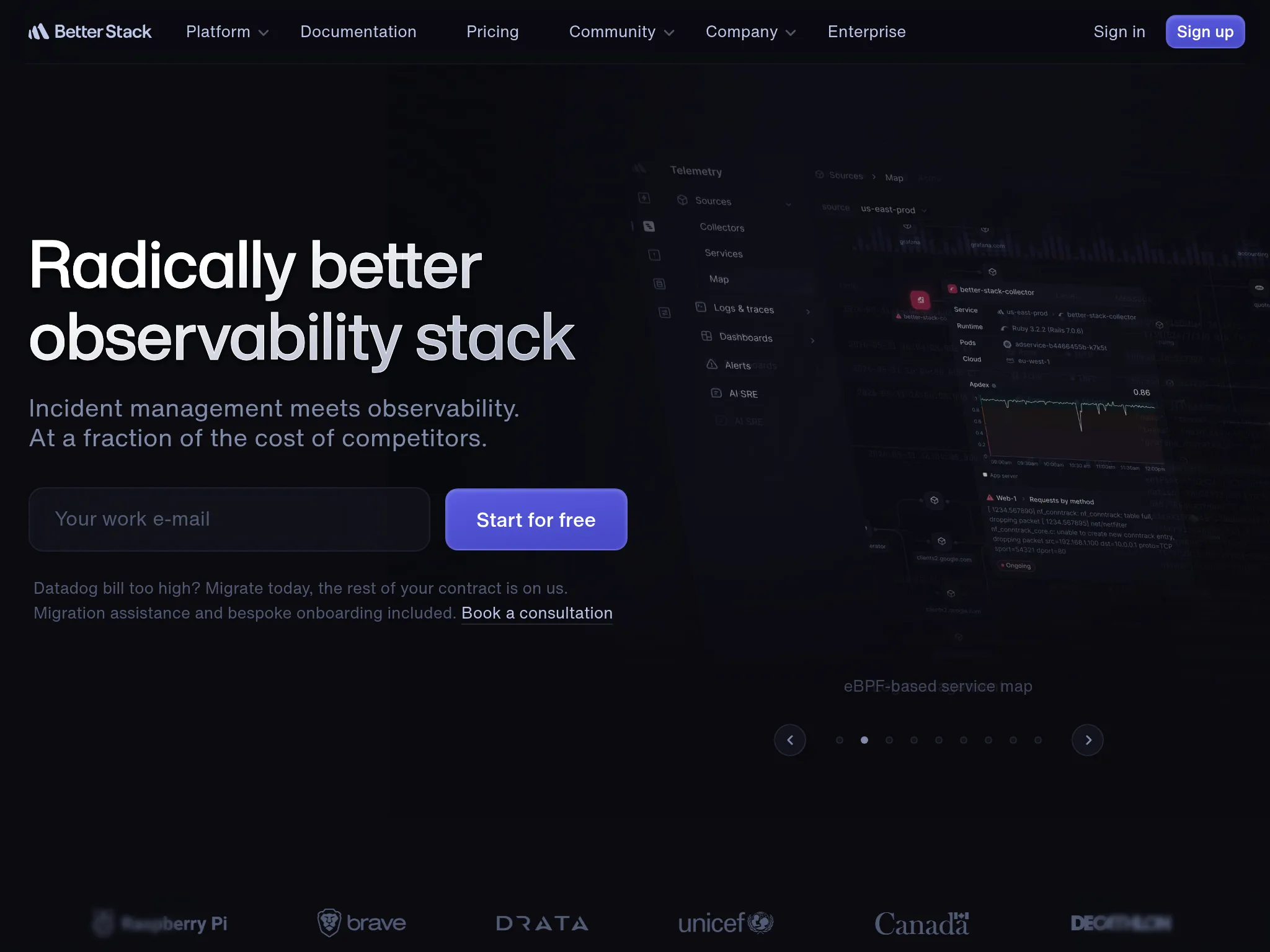
Teams that want uptime monitoring tightly integrated with logs, metrics, and incident management. Better Stack works well when you need to move quickly from "something's down" to "here's why and here's the fix."
From what I gathered in G2 reviews, this integration is the main reason teams choose it over standalone monitoring tools.
What Better Stack actually does: Key features
- Unified incident timeline: When an alert fires, you immediately see related logs, metrics, and screenshots in one view. Multiple reviewers called out how this speeds up troubleshooting compared to jumping between tools.
- On-call scheduling: Built-in rotations, escalation chains, and SMS/voice alerts. The on-call functionality gets consistent praise for reliability.
- Terraform provider: DevOps teams appreciate being able to define monitors and on-call policies as code.
- Log management: Not just monitoring, you get centralized logging with SQL-like queries and real-time tailing. This dual capability is unique among the three tools I'm comparing.
- Global probes: Multi-region checks to verify outages aren't just network blips from one location.
What I like about Better Stack
The integration between components genuinely works. When I read through reviews, a common theme was how seamlessly everything flows from detection to investigation to resolution. One user described it as "having all the context you need without switching tabs."
The Terraform support also stands out. If you're managing infrastructure as code, Better Stack fits naturally into that workflow in a way the other two tools don't emphasize as heavily.
What G2 users like about Better Stack
"The integration of log management with incident timelines and screenshots provided a holistic view of outages and errors, streamlining root cause analysis and post-incident reviews. Automated AI post-mortems and detailed reporting features supported a culture of continuous improvement."
"I love using Better Stack, it's easy to implement, has very good customer support, I use it often, there are quite a few features, and their API is super simple to integrate."
How much does Better Stack cost?
Better Stack's pricing is usage-based and seat-based.
- Users: $29/mo/responder (but unlimited team members who aren’t responders)
- Status pages: Many features for status pages are paid addons
- Monitors: After the free limits, it’s $21/mo for every 50 monitors, $17/mo for every 10 cron job monitors, and $1 for every 100 Playwright minutes (synthetic monitoring)
Several G2 reviewers mentioned that while pricing is competitive at smaller scales, it can climb quickly for larger deployments or heavy log volumes.
What Better Stack is not good at
From the reviews I analyzed, pricing transparency is the main friction point. Users frequently noted that while the platform itself is excellent, predicting monthly costs requires careful estimation of hosts, log volume, and alert channels.
The interface is praised as modern and intuitive, but mastering all the features takes time. Several reviewers mentioned needing dedicated onboarding to unlock the platform's full potential.
Better Stack is also less mature than Uptime.com in specialized areas like synthetic transaction monitoring. If you need detailed browser-based flow testing, Uptime.com's purpose-built tools are more advanced.
Is Better Stack right for you?
DevOps teams and SREs managing cloud-native infrastructure who want to consolidate monitoring, logging, and incident response. It's particularly strong for teams already using infrastructure-as-code practices and those who value modern tooling over established enterprise vendors.
Uptime.com: Best for comprehensive monitoring and reporting
Perfect for
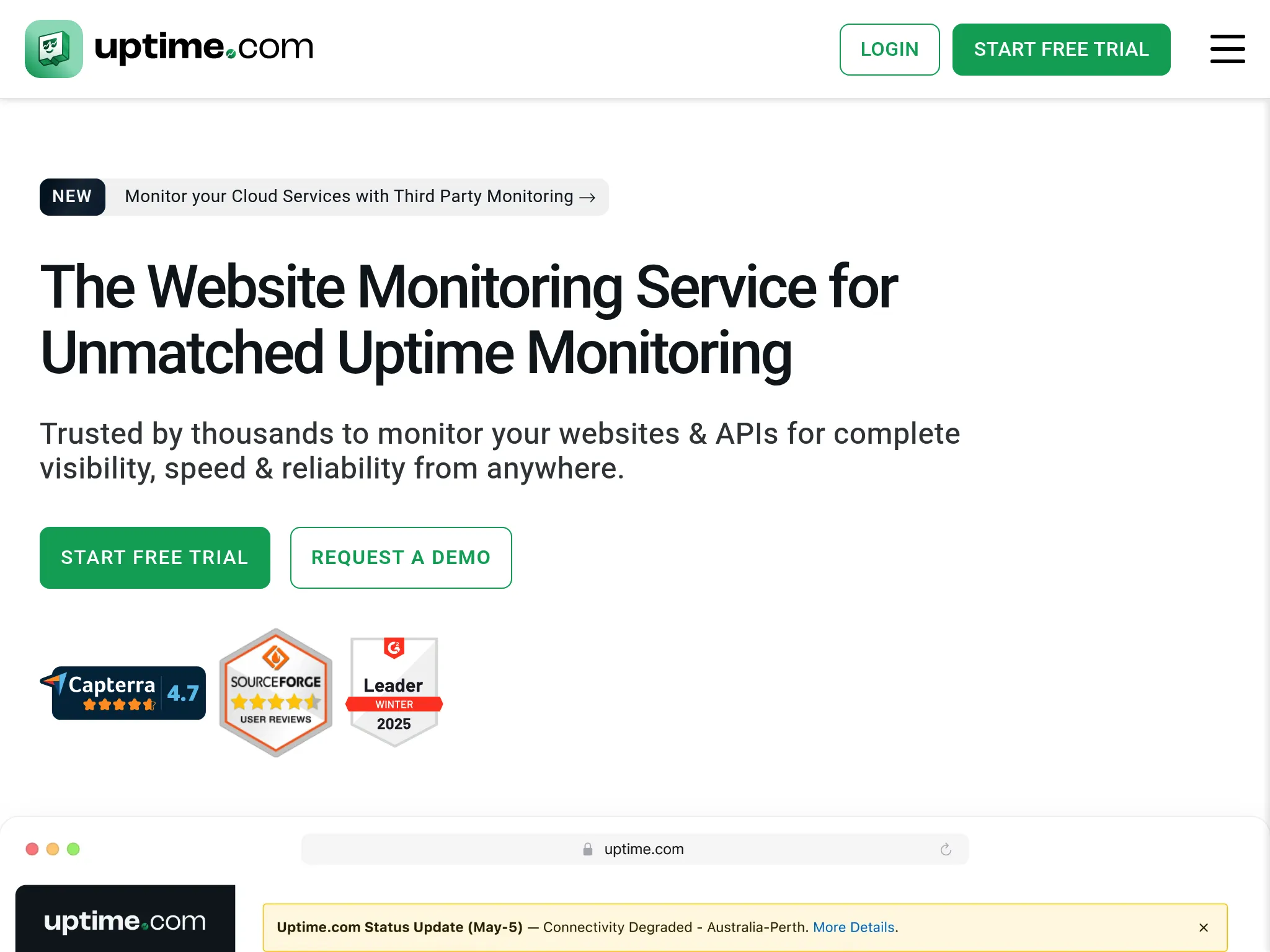
Organizations that need detailed transaction monitoring, formal SLA reporting, and comprehensive coverage across websites, APIs, and infrastructure. Uptime.com is built for teams that have to prove uptime to customers or comply with strict availability requirements.
From what I discovered in user feedback, Uptime.com is the most feature-rich of the three platforms. It covers basic HTTP checks all the way through complex synthetic transactions with real browser testing.
What Uptime.com actually does: Key features
- Transaction monitoring: Browser-based flows with Playwright support to test complete user journeys. Users consistently praise this as more mature than competing platforms.
- 80+ global monitoring locations: The largest probe network of the three tools, useful for verifying global availability.
- Real User Monitoring (RUM): Track actual user experience alongside synthetic checks, giving you both external monitoring and real-world data.
- Comprehensive check types: HTTP(S), DNS, SSL, TCP, UDP, SMTP, IMAP, POP, SSH, and more. If you need to monitor it, Uptime.com probably supports it.
- SLA reporting: Automated reports with historical data, downtime analysis, and customizable formats for sharing with stakeholders.
What I like about Uptime.com
The depth of monitoring capabilities is unmatched. If you're monitoring anything beyond basic website availability, Uptime.com likely has a pre-built check type for it. The transaction monitoring in particular gets consistent praise for handling complex, multi-step flows reliably.
I also noticed that Uptime.com users frequently mention the reporting capabilities. If you need to present uptime data to executives or customers, the built-in reports save significant time compared to building them manually.
What G2 users like about Uptime.com
"What stands out most is the accuracy and speed of their alerts—we're notified instantly of any downtime or performance issues, which allows us to respond proactively before customers are even impacted. The dashboard is clean and user-friendly, making it easy for both technical teams and leadership to understand system health at a glance."
"We use uptime to alert us immediately in case of a site, API, or server outage, allowing us to act before users are impacted. The platform centralizes everything: uptime monitoring, alerts, incident management, and status pages, which greatly simplifies our workflow."
How much does Uptime.com cost?
Uptime.com doesn’t have plans but has tiered pricing based on usage. It comes with unlimited users by default.
- $7/mo for 10 basic checks, 1 advanced check, and 25 SMS alerts
- $30/mo for 50 basic checks, 5 advanced checks, and 75 SMS alerts
- $60/mo for 100 basic checks, 10 advanced checks, and 100 SMS alerts
- $600/mo for 1000 basic checks, 100 advanced checks, and 1500 SMS alerts
While pricing is similar to other tools until around 100 checks, it gets much more expensive than Hyperping after that.
What Uptime.com is not good at
Cost is the primary tradeoff. Multiple G2 reviewers mentioned that while Uptime.com delivers excellent value, the price can be steep for smaller teams or organizations with simpler monitoring needs.
The feature set is comprehensive, but several users noted that this can translate to complexity. Setting up advanced transaction monitoring or configuring custom checks takes time and technical knowledge. The UI is functional but not as modern as Better Stack's interface.
False positives came up occasionally in reviews, though users noted they're relatively rare. The Terraform support exists but isn't as mature as Better Stack's implementation.
Is Uptime.com right for you?
Mid-market to enterprise organizations with complex monitoring requirements, particularly those needing comprehensive SLA documentation. It's a strong fit for MSPs, hosting providers, SaaS companies with uptime guarantees, and IT teams managing critical infrastructure where detailed reporting matters.
Hyperping: Best for straightforward monitoring
Perfect for
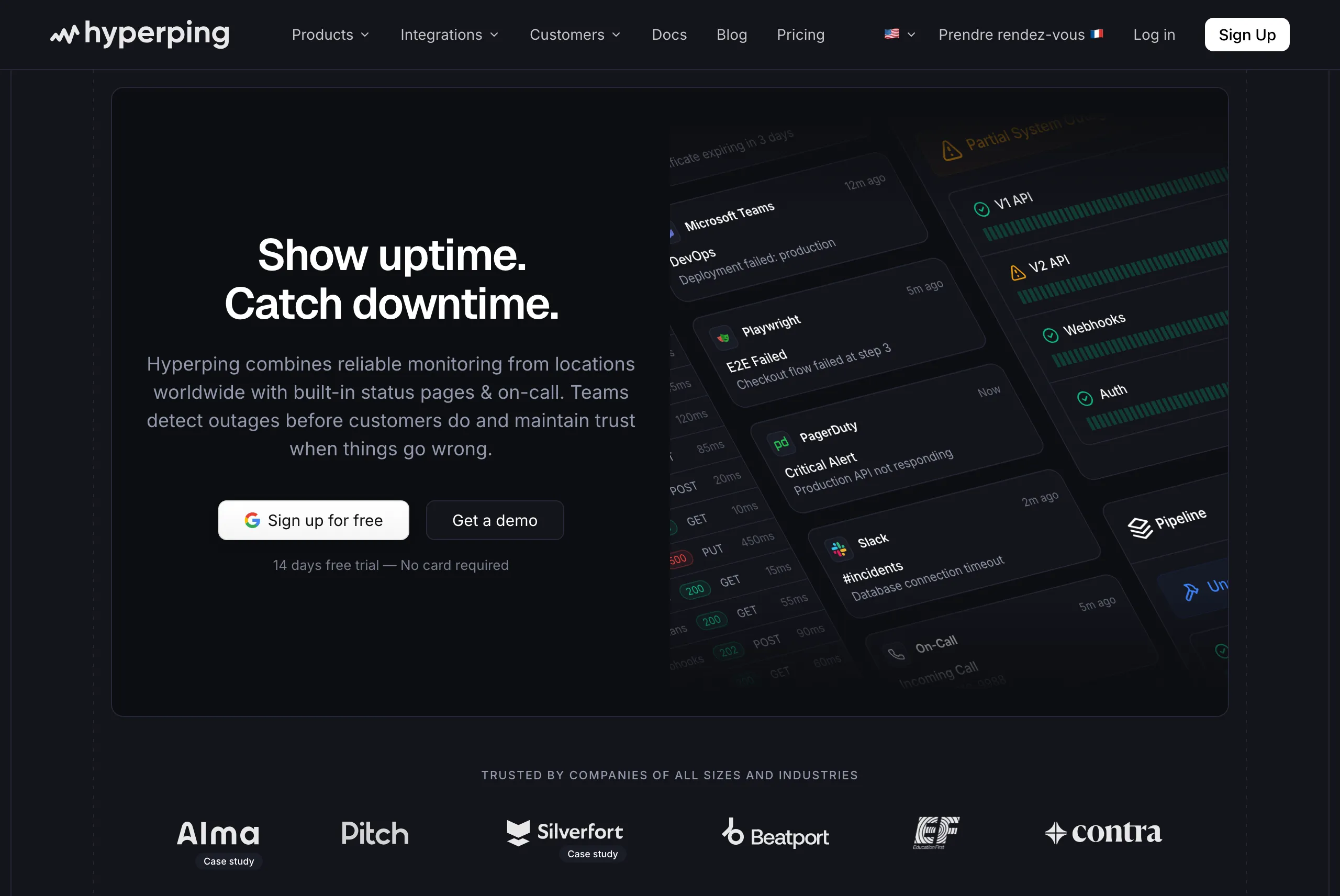
Teams that want reliable uptime monitoring without complexity or budget strain. Hyperping focuses on doing the essentials extremely well rather than adding every possible feature.
From the reviews and conversations I analyzed, Hyperping appeals to teams that value simplicity and predictable pricing. It's particularly popular with European companies due to GDPR compliance and EU hosting.
Notable features include
- 30-second check intervals: Faster than Uptime.com, matching Better Stack's frequency. It’s even 10-second for the Business plan.
- Multiple full-featured status pages: On Pro plan, you get 3 status pages, each with custom domains and branding.
- Browser-based transaction monitoring: Uses Playwright for synthetic testing, though less mature than Uptime.com's implementation
- On-call scheduling and smart escalation policies: Streamline incident response with automated on-call scheduling, smart escalation policies, and multi-timezone coordination. Built for global teams.
- Voice call alerts: Included even on lower tiers
- European hosting: GDPR-compliant infrastructure for teams with data residency requirements
Why choose Hyperping?
Key reason #1: Predictable, transparent pricing that doesn't explode as you scale
Unlike Better Stack's usage-based model (where costs depend on log volume, check types, and responder count) or Uptime.com's premium pricing, Hyperping offers flat-rate plans with no hidden usage fees. You know exactly what you'll pay each month—no surprises when you add more monitors or your team grows.
This matters when you're budgeting for the year or pitching monitoring costs to finance. With Better Stack, adding 50 monitors costs $21/month, plus $29 per responder, plus potential overages on Playwright minutes. With Hyperping, 250 monitors and 3 status pages cost $74/month, period.
Key reason #2: Complete monitoring platform without the enterprise complexity
Most tools force you to choose: simple but limited (basic ping monitors), or powerful but overwhelming (full observability suites requiring dedicated training). Hyperping delivers advanced capabilities like synthetic monitoring with Playwright, on-call scheduling, smart escalation policies, wrapped in an interface you'll actually want to use.
You get 30-second check intervals (10 seconds on Business plan) that match Better Stack and beat Uptime.com's standard 60-second frequency. You get synthetic monitoring for testing critical user flows like checkout or signup.
But unlike Better Stack's learning curve or Uptime.com's feature sprawl, Hyperping's focused feature set means you're monitoring in minutes, not hours.
Key reason #3: EU-based monitoring that doesn't compromise on features
Most monitoring tools were built in the US and retrofitted for GDPR compliance as an afterthought. Hyperping is designed from the ground up for European data regulations. Your monitoring data stays in EU data centers, managed by EU companies, with no data transfers to third countries.
For EU-based companies, this isn't just a nice-to-have. It's about avoiding legal complexity and data transfer agreements that come with US-hosted tools. When Better Stack or Uptime.com process your monitoring data (which includes URLs, response content, and potentially customer data), you're managing cross-border data flows and SCCs (Standard Contractual Clauses).
With Hyperping, compliance is built in. You get full compliance without sacrificing features: multiple status pages, synthetic monitoring, on-call scheduling, and 30-second checks, all while keeping your data in Europe.
This matters especially for companies in regulated industries (healthcare, finance, government contractors) or those serving European customers who expect GDPR-first vendors. Your monitoring tool shouldn't create compliance headaches.
What I like about Hyperping
You know exactly what you're paying each month without calculating check volumes or worrying about usage spikes. Several reviewers specifically called this out as a major advantage when budgeting.
The setup experience gets consistent praise. Users report being up and running in minutes rather than hours. For teams that don't need advanced features, this simplicity is valuable.
What G2 users like about Hyperping
Users consistently praise the "fast setup & low friction" and describe it as taking "minutes to first monitor and a usable status page." The "clean, modern UI" is frequently mentioned as making it "easy to find failing checks and ship incident updates quickly."
The status page aesthetics are a recurring theme: users say they "look right for customer-facing comms without custom code."
How much does Hyperping cost?
Hyperping's pricing is notably simpler than the alternatives:
- Essentials: $24/month for up to 3 seats, 50 monitors, 1 status page, and 3 browser checks
- Pro: $74/month billed annually for 250 monitors, 10 browser checks, 10 seats, and 3 public or private status pages. Includes email access codes, multilingual pages, and native account SAML SSO.
The Pro plan at $74/month delivers the core functionality most teams need. Compared to Better Stack or Uptime.com at similar scales, this represents significant savings.
What Hyperping is not good at
Hyperping doesn't try to be a full observability platform. You won't get integrated log management like Better Stack or the depth of synthetic testing that Uptime.com offers. If you need those capabilities, you'll need to use additional tools.
The advanced synthetics are described as "less mature" compared to Uptime.com. If complex browser flows are critical to your monitoring strategy, Uptime.com's purpose-built tools are more sophisticated.
Is Hyperping right for you?
Startups, SMBs, and indie developers who want solid monitoring without overpaying or over-configuring. It's particularly appealing for European companies that value GDPR compliance, teams with straightforward monitoring needs, and anyone frustrated by usage-based pricing models.
Frequently asked questions
Can I use multiple tools together?
We have customers using Hyperping on top of bigger tools like Datadog or AWS CloudWatch.
"In addition to CloudWatch, we also want to have a view on our system from the outside. And this is where Hyperping comes in. It is basically an independent monitoring solution for us, just looking from the outside, pinging the API and the websites and all the crucial parts of our infrastructure."
What about open-source alternatives?
Tools like Uptime Kuma offer free monitoring but require self-hosting and maintenance. If you have the infrastructure and time, they're worth considering. Most teams I spoke with prefer the reliability and support of managed services.
How important is check frequency?
Our customer praise the speed of the alerts from Hyperping. They say it's usually faster than the other monitoring tools they use. So 30-second checks are definitely worth it.
"We have the real-time alerts from Hyperping telling us if the app is down. These are sometimes arriving even before AWS notices or notifies us. So, that's a crucial part in our daily process."
How to test these tools before you commit
All three platforms offer trials or free tiers:
- Better Stack: Free tier available for testing
- Uptime.com: Trial period
- Hyperping: Free tier and also a 14-day free trial on all paid plans
Start with the free options that match your use case. Run them in parallel with your existing monitoring for a week to see which fits your workflow. Pay attention to false positive rates, alert reliability, and how quickly you can investigate issues when they occur.
The monitoring space is mature, so switching costs are low. Most teams I spoke with had tried 2-3 tools before settling on their current choice. Don't feel locked in by your first decision.
FAQ
How do Better Stack, Uptime.com, and Hyperping compare for uptime monitoring? ▼
Better Stack is best for unified observability (monitoring + logs + incidents), Uptime.com for enterprise-grade synthetic monitoring and SLA reporting, and Hyperping for cost-effective monitoring with on-call scheduling, status pages, and predictable flat-rate pricing starting at $24/month.
Which monitoring tool has the most predictable pricing? ▼
Hyperping offers flat-rate pricing with included seats, paid additional seats and no usage-based surprises. Better Stack uses usage-based billing (per responder, per 50 monitors, plus log volume), and Uptime.com scales steeply at higher tiers ($600/month for 1000 monitors vs Hyperping's $249/month).
Which tool is cheapest for 1000 monitors: Better Stack, Uptime.com, or Hyperping? ▼
Hyperping is the most affordable at $249/month for 1000 monitors, 10 status pages, and 20 seats. Better Stack costs approximately $391/month (1 responder plus add-ons), and Uptime.com reaches $600/month at the same scale.
Which monitoring tool is best for EU-based teams needing GDPR compliance? ▼
Hyperping is the strongest choice. It's a French company with all data stored in EU data centers, designed from the ground up for GDPR compliance with no data transfers to third countries. Better Stack and Uptime.com are US-based, requiring cross-border data transfer agreements and Standard Contractual Clauses.
Can I get monitoring, status pages, and on-call scheduling in one platform? ▼
Yes. Hyperping combines 30-second uptime checks, fully branded status pages with custom domains, and on-call scheduling with smart escalation policies in a single platform. Better Stack offers a similar combination but with usage-based pricing, while Uptime.com focuses on monitoring and reporting without built-in on-call scheduling.