How to setup a custom domain for your status page
Host your status page under your own custom domain.
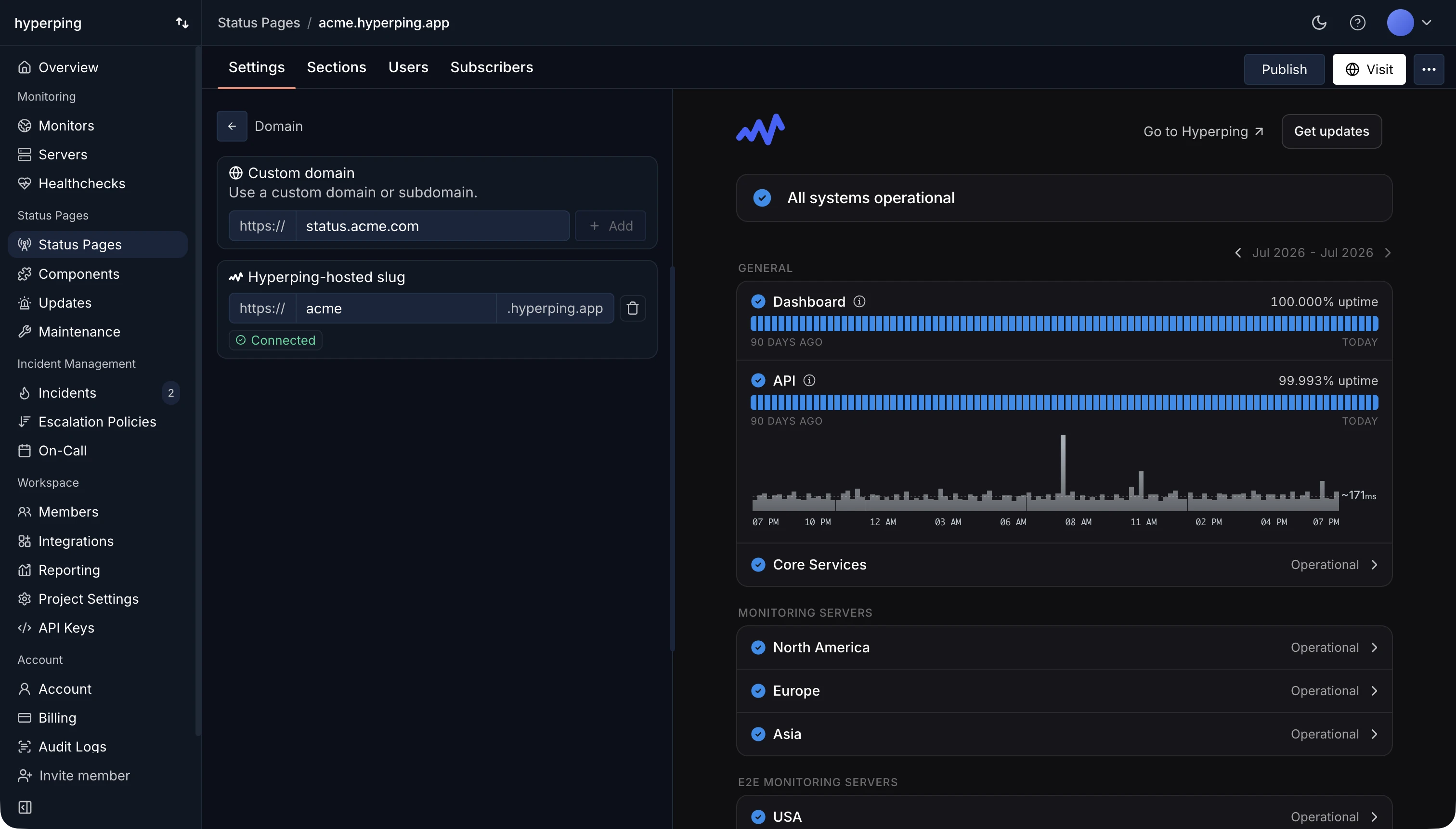
Custom domain
Host your status page under any custom domain: either your apex domain (acme.com) or any subdomain (status.acme.com, uptime.acme.com, internal.status.acme.com, etc.).
- Open Status Pages
Go to Status Pages in your Hyperping dashboard.
- Pick a status page
Pick the status page you want to add a domain to.
- Enter your custom domain
Enter your custom domain in the "Custom domain" section.
- Publish
Hit Publish.
- Configure your DNS records
Add the record shown in the panel to your DNS zone. The exact name and value are displayed with a copy button next to each one.
DNS records
| Domain | Type | Name | Value |
|---|---|---|---|
| Subdomain (status.acme.com) | CNAME | status | cname.hyperping.io |
| Apex domain (acme.com) | A | @ | 216.150.1.1 |
The Name is relative to your DNS zone, so a page on internal.status.acme.com uses internal.status, not the full hostname. Most DNS providers add the rest for you.
Once the record is saved, leave the Domain panel open. It rechecks your DNS on its own, and you can force a check with the Check DNS button. When everything resolves, the panel shows Connected · SSL certificate active and we email you that the page is live.
Domain verification (TXT record)
A third record sometimes appears in the panel: a TXT record named _vercel. It shows up when your domain is already in use on the infrastructure that serves status pages, most often because your main website is hosted on Vercel. In that case we need proof that the domain is yours before we can serve a page on it.
The record is temporary and does not route any traffic. It only proves ownership. A few things to know:
- It always goes on your apex domain (_vercel.acme.com), even when your status page lives on a subdomain.
- Its value is unique to your domain. Copy it from the panel rather than from another guide.
- Once the panel flips to Connected, the record has done its job. Leaving it in place is harmless and saves a round trip if you ever re-add the domain.
SSL certificates (HTTPS)
All status pages are served using HTTPS only, and HTTP requests are redirected to HTTPS. We issue and renew the certificate for you (Let's Encrypt), so there is nothing to upload, and renewal happens automatically 30 days before expiry.
The certificate is only issued once your domain actually resolves to us, which means the order matters: DNS first, certificate second. Between the two, a browser hitting your domain can show a certificate warning or a "site not found" error. That is expected and clears on its own, usually within a minute of the DNS check passing.
Two DNS settings can block the certificate from ever being issued:
- A Cloudflare proxied record (orange cloud). Cloudflare answers for the hostname instead of us, so the validation never reaches our servers. Switch the record to DNS only (grey cloud).
- A restrictive CAA record on your domain. If you use CAA records, they must allow letsencrypt.org to issue certificates, otherwise the request is refused.
Hyperping-hosted domain
Each status page can have a custom Hyperping-hosted domain (yourdomain.hyperping.app) that is instantly available. This is perfect for testing your status page or in case obtaining a custom domain requires more time.
Head to your status page settings, edit the field under the "Hyperping-hosted slug" section, then hit "Publish".
All Hyperping-hosted status pages are served using HTTPS only.
Troubleshooting
My custom domain is not live yet
DNS propagation can take up to 24 hours after you create the record, though it is usually a matter of minutes. In the meantime, your Hyperping-hosted domain (yourdomain.hyperping.app) is instantly available, so you already have a working URL to share.
My domain is on Cloudflare and nothing works
Open the record in Cloudflare and set it to DNS only (grey cloud). While the orange cloud is on, Cloudflare answers for your hostname with its own IP addresses, so our DNS check fails and the SSL certificate cannot be issued. The panel flags this for you when it detects Cloudflare's edge.
The panel says my domain points somewhere else
Something already answers for that hostname: a previous status page provider, a parking page, or a typo in the target. Adding a second record does not help, and if the existing record is the wrong type (an A record where we need a CNAME), your provider will reject the new one. Edit the existing record instead of creating another.
I added the TXT record and it still says pending
Check that you added it rather than replaced your existing TXT records, that the name is _vercel on your apex domain, and that the value matches the panel exactly (no quotes, no trailing spaces). Then hit Check DNS. If your provider shows the record but we still do not see it, give it a few minutes: some registrars only publish TXT changes on their own refresh cycle.